

Plato’s allegory of the cave is a classic philosophical parable in The Republic, used as a metaphor for humanity’s process of recognizing truth by dividing the world into the “phenomenal realm" of sensory experience and the “realm of forms" accessible through reason. Most people can only see shadows on the wall, mistaking them for reality; when someone escapes the cave to see the real world and the sun (representing the “Form of the Good"), they return to awaken others but are not understood. Just as we are confined to the cognitive boundaries of four-dimensional space, though we cannot escape this boundary, AI model computations are like installing a mirror on the cave wall—we need not leave the boundary to reflect the reality behind through model computations, helping us pursue essence.
柏拉圖的洞穴隱喻是《理想國》中一個經典的哲學寓言,用來比喻人類認識真理的過程,將世界分為感官經驗的「現象界」與理性的「理念界」。大多人只能看到牆上的影子,誤認為是真實;當有人逃出洞穴看到真實世界和太陽(代表「善」的理念)後,回頭試圖喚醒他人,卻不被理解。就像我們被困在四維空間的認知邊界,雖然我們走不出這個邊界,但AI 模型的運算就像在洞穴的牆上裝了一面鏡子,我們不用走出邊界也可依模型運算反射背後的真實,協助我們追求本質。
Abstract
This paper aims to overcome the conceptual and mathematical obstacles in unifying quantum mechanics and general relativity by proposing an axiomatic mathematical framework based on “Information Ontology." We hypothesize that the fundamental layer of physical reality is not continuous spacetime geometry, but rather a discrete, high-dimensional Information-Relational Network. We first define a generalized “information state space" based on an inner product structure using mutual information. To comply with quantum mechanics’ principle of information conservation, we model the network’s dynamical evolution as a Non-local Unitary Operator acting on high-order correlation tensors, rather than the lossy mechanisms in traditional deep learning. The intrinsic discreteness of tokens provides a natural ultraviolet cutoff for the theory, circumventing the renormalization divergence problems in traditional quantum gravity. Finally, using the Holographic Principle and the ER=EPR conjecture, we interpret four-dimensional spacetime as the projected boundary of high-dimensional information structures and, combined with the Ryu-Takayanagi formula, argue that gravitational geometry is an effective manifestation of global quantum entanglement entropy gradients.
1. Introduction: The Mathematical Impasse of Geometric Unification and Ontological Shift
Modern physics faces fundamental mathematical difficulties when attempting to unify quantum field theory (QFT) and general relativity (GR). QFT is built upon operator algebras and probability amplitudes on flat backgrounds, with computational processes often producing ultraviolet divergences due to continuous spacetime assumptions, requiring renormalization techniques; GR is built upon dynamically curved differential manifolds, whose nonlinear characteristics cause standard quantization methods to fail, leading to non-renormalizable infinities [1].
To overcome this impasse, this framework proposes an ontological shift:
Postulate I (Ontological Shift): The fundamental constituents of the physical universe are not matter and energy in spacetime, but abstract discrete information-relational units. The continuous four-dimensional spacetime manifold M(3,1)M(3,1) and its geometric properties (such as curvature) are emergent phenomena under specific observational constraints from high-dimensional discrete information structures.
2. Kinematics: High-Dimensional Information-Relational Networks Based on Tokens
We construct a mathematical structure capable of accommodating the above postulate.
2.1 Information State Space and Relational Inner Product
We define a discrete basis set

, called tokens, as minimal information cells. They span a high-dimensional vector space called the information state space .

Unlike standard Hilbert spaces where inner products represent probability amplitudes, we define the inner product in as correlation intensity:

where is some normalized two-body correlation measure, such as quantum mutual information. This provides a unified mathematical foundation for semantic embedding and physical correlation.
2.2 Global State and Correlation Tensor
The global state of the universe is the joint state of all tokens, residing in the many-body tensor product space:
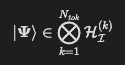
This state encodes all possible nn-body correlations. The topological structure of physical reality is described by a high-order correlation tensor (Relational Tensor) RR, whose components are given by many-body mutual information:
Ri1i2…in=In(Ti1;Ti2;… ;Tin)Ri1i2…in=In(Ti1;Ti2;…;Tin)

In this framework, so-called “extra dimensions" are no longer extensions of geometric coordinates, but measures of information complexity. The effective dimension DeffDeff corresponds to some rank of the correlation tensor (such as Schmidt Rank) or the degrees of freedom of global entanglement entropy.
3. Dynamics: Non-local Unitary Evolution and Discreteness
To ensure the physical self-consistency of the theory, particularly compliance with quantum mechanics’ principle of information conservation, we must carefully define the evolution operator.
3.1 Unitarity and Information Conservation
Early model attempts used operators analogous to deep learning attention mechanisms with Softmax, but such operators are typically non-unitary, leading to probability non-conservation and information loss. In this revised framework, the discrete-time evolution of the universe must be governed by a unitary operator :

Unitarity guarantees that the norm of the global information state remains invariant, consistent with the quantum mechanical correspondence of Liouville’s Theorem, ensuring information is neither spontaneously created nor destroyed during evolution [2]. This evolution can be viewed as an entropy-preserving, non-local quantum information reconstruction process.
3.2 Discreteness as a Natural Renormalization Mechanism
Divergences in traditional quantum field theory stem from integrating over infinitesimally small distance modes in continuous spacetime. In this framework, tokens are indivisible minimal units, meaning there exists a natural minimum length scale (analogous to the Planck length lPlP).
Therefore, path integrals in dynamical calculations are replaced by finite tensor network summations:
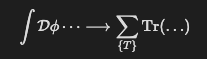
This intrinsic discreteness provides a natural ultraviolet cutoff, mathematically circumventing the infinite divergences that cause gravity’s non-renormalizability, making the theory more mathematically well-defined.
4. Observation and Projection: Holographic Principle and Emergent Gravity
How do we recover the observed four-dimensional spacetime and gravity from the high-dimensional information network?
4.1 Projection, Information Loss, and ER=EPR
Observation can be viewed as a projection mapping from the high-dimensional information space to the low-dimensional manifold M(3,1)M(3,1).

A key challenge is explaining the apparent information loss during projection without introducing contradictions similar to the black hole firewall paradox.
We invoke the ER=EPR conjecture [3] to resolve this issue. This conjecture posits that quantum entanglement (EPR pairs) and wormholes (Einstein-Rosen bridges) in spacetime geometry are two descriptions of the same physical entity.
Quantum Entanglement (EPR) ⟺ Geometric Connection (ER Bridge)Quantum Entanglement (EPR)⟺Geometric Connection (ER Bridge)
From this perspective, the projection does not simply “discard" high-dimensional information, but rather maps long-range, non-local entanglement information into microscopic wormhole structures connecting different regions in spacetime geometry. Information that appears “lost" in local projection is actually encoded in the non-trivial topological connections of spacetime, thereby guaranteeing the integrity of global information.
4.2 Rigorous Derivation of Gravitational Geometry: The Ryu-Takayanagi Formula
We further use the holographic principle to quantitatively link information correlation with geometry. According to the Ryu-Takayanagi (RT) formula [4] in AdS/CFT correspondence, the entanglement entropy SASA of a region AA in boundary conformal field theory equals the area of the minimal surface in the bulk that is homologous to that region:
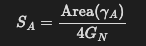
In our framework, we generalize this: four-dimensional spacetime is the “boundary" of the high-dimensional correlation network, and geometric properties of any region in spacetime (such as area, distance) directly correspond to the entanglement entropy of the corresponding subsystem in the information network.
Therefore, the gravitational metric tensor is no longer a fundamental quantity, but rather a geometric manifestation of information distribution inhomogeneity. Spacetime curvature arises from gradient variations in entanglement entropy:

This provides a mathematical path to rigorously derive Einstein’s field equations from the abstract information correlation tensor, demonstrating that gravity is indeed an emergent entropic force phenomenon [5].
5. Conclusion and Outlook
This paper proposes a unified field theory mathematical framework based on information ontology. By introducing discrete tokens as fundamental information elements, we define a high-dimensional correlation tensor network to describe physical reality. We have revised earlier dynamical models, emphasizing the unitarity of evolution operators to ensure information conservation, and utilize the discreteness of tokens as a natural renormalization mechanism to resolve divergence problems. Finally, combining the ER=EPR conjecture and the Ryu-Takayanagi formula, we argue how four-dimensional spacetime and gravitational geometry holographically emerge from high-dimensional information entanglement structures.
This framework provides a new research direction for quantum gravity. Future challenges lie in constructing concrete tensor network models and quantitatively calculating physical parameters such as the Standard Model gauge groups and the cosmological constant.
References
[1] S. Weinberg, “The Quantum Theory of Fields, Vol. 1: Foundations," Cambridge University Press (1995). (Standard textbook on quantum field theory and renormalization problems)
[2] M. A. Nielsen and I. L. Chuang, “Quantum Computation and Quantum Information," Cambridge University Press (2010). (Foundational theory on quantum information, unitary evolution, and information conservation)
[3] J. Maldacena and L. Susskind, “Cool horizons for entangled black holes," Fortschritte der Physik 61, 781 (2013). [arXiv:1306.0533 [hep-th]]. (Proposes the ER=EPR conjecture, linking entanglement with spacetime geometry)
[4] S. Ryu and T. Takayanagi, “Holographic Derivation of Entanglement Entropy from AdS/CFT," Physical Review Letters 96, 181602 (2006). [arXiv:hep-th/0603001]. (Foundational formula establishing the quantitative relationship between entanglement entropy and geometric area)
[5] E. Verlinde, “On the Origin of Gravity and the Laws of Newton," Journal of High Energy Physics 2011, 29 (2011). [arXiv:1001.0785 [hep-th]]. (Important paper on gravity as an emergent entropic force)
[6] B. Swingle, “Entanglement Renormalization and Holography," Physical Review D 86, 065007 (2012). [arXiv:0905.1317 [cond-mat.str-el]]. (Explores the relationship between tensor networks, renormalization, and holographic correspondence)
摘要 (Abstract)
本文旨在克服量子力學與廣義相對論統一過程中的概念與數學障礙,提出一個基於「信息本體論(Information Ontology)」的公理化數學框架。我們假設物理實相的基本層並非連續的時空幾何,而是一個離散的、高維的信息關聯網絡(Information-Relational Network)。我們首先定義了一個基於互信息(Mutual Information)內積結構的廣義「信息態空間」。為了遵循量子力學的信息守恆原則,我們將網絡的動力學演化建模為作用於高階關聯張量上的非局域么正運算子(Non-local Unitary Operator),而非傳統深度學習中的有損機制。Token 的本徵離散性為理論提供了天然的紫外截斷,規避了傳統量子重力中的重整化發散問題。最後,我們利用全息原理(Holographic Principle)和 ER=EPR 猜想,將四維時空解釋為高維信息結構的投影邊界,並結合 Ryu-Takayanagi 公式論證重力幾何是全域量子糾纏熵梯度的有效表現。
一、 引言:幾何統一路徑的數學困境與本體論轉移 (Introduction: The Mathematical Impasse of Geometric Unification and Ontological Shift)
現代物理學在嘗試統一量子場論(QFT)與廣義相對論(GR)時面臨根本性的數學困難。QFT 建立在平直背景上的算子代數與機率幅之上,其計算過程常因連續時空假設而產生紫外發散,需要重整化技術來處理;GR 則建立在動態彎曲的微分流形上,其非線性特徵使得標準的量子化方法失效,導致不可重整化的無窮大 [1]。
為了克服這一僵局,本框架提出一個本體論層面的轉移:
公設 I (Ontological Shift): 物理宇宙的基本構成不是時空中的物質與能量,而是抽象的離散信息—關係單元(Information-Relational Units)。連續的四維時空流形 $\mathcal{M}^{(3,1)}$ 及其上的幾何性質(如曲率),是高維離散信息結構在特定觀測限制下的湧現現象(Emergent Phenomena)。
二、 運動學:基於 Token 的高維信息關聯網絡 (Kinematics: High-Dimensional Information-Relational Networks Based on Tokens)
我們構建一個能夠容納上述公設的數學結構。
2.1 信息態空間與關係內積 (Information State Space and Relational Inner Product)
我們定義一個離散的基底集合
稱為Token,作為最小信息原胞。它們張成一個高維向量空間,稱為信息態空間 。
不同於標準希爾伯特空間中內積代表機率幅,我們定義 中的內積為關聯強度(Correlation Intensity):
其中 是某種規範化的兩體關聯度量,例如量子互信息(Quantum Mutual Information)。這為語義嵌入與物理關聯提供了統一的數學基礎。
2.2 全域狀態與關聯張量 (Global State and Correlation Tensor)
宇宙的全域狀態 是所有 Token 的聯合狀態,位於多體張量積空間中:
這個狀態編碼了所有可能的 $n$-體關聯。物理實相的拓撲結構由一個高階關聯張量(Relational Tensor) 描述,其分量由多體互信息給出:
在此框架下,所謂的「額外維度」不再是幾何坐標的擴展,而是信息複雜度的度量。有效維度 對應於關聯張量的某種秩(如 Schmidt Rank)或全域糾纏熵的自由度。
三、 動力學:非局域么正演化與離散性 (Dynamics: Non-local Unitary Evolution and Discreteness)
為了確保理論的物理自洽性,特別是符合量子力學的信息守恆(Information Conservation)原則,我們必須審慎定義演化算子。
3.1 么正性與信息守恆 (Unitarity and Information Conservation)
早期的模型嘗試使用類比深度學習 Attention 機制的 Softmax 算子,但這類算子通常是非么正的(Non-unitary),會導致機率不守恆和信息丟失。在本修正框架中,宇宙的離散時間演化必須由一個么正算子(Unitary Operator) 支配:
么正性保證了全域信息態的範數不變,符合劉維爾定理(Liouville’s Theorem)在量子力學中的對應,確保信息不會在演化過程中憑空產生或消失 [2]。這種演化可以被視為一種保熵的、非局域的量子信息重構過程。
3.2 離散性作為天然重整化機制 (Discreteness as a Natural Renormalization Mechanism)
傳統量子場論中的發散源於對連續時空中無限小距離模式的積分。在本框架中,Token 是不可再分的最小單元,這意味著存在一個天然的最小長度尺度(Minimum Length Scale)(類比普朗克長度 $l_P$)。
因此,動力學計算中的路徑積分被替換為有限的張量網絡求和:
這種本徵的離散性提供了一個天然的紫外截斷(Ultraviolet Cutoff),從數學上規避了導致重力不可重整化的無窮大發散問題,使得理論在數學上更加良態定義(Well-defined)。
四、 觀測與投影:全息原理與重力湧現 (Observation and Projection: Holographic Principle and Emergent Gravity)
如何從高維信息網絡中恢復出我們觀測到的四維時空與重力?
4.1 投影、信息丟失與 ER=EPR (Projection, Information Loss, and ER=EPR)
觀測可以被視為一個從高維信息空間
。一個關鍵挑戰是如何解釋投影過程中的信息表觀丟失而不引發類似黑洞火牆(Firewall Paradox)的矛盾。
我們引入 ER=EPR 猜想 [3] 來解決此問題。該猜想認為,量子糾纏(EPR對)與時空幾何中的蟲洞(Einstein-Rosen橋)是同一物理實體的兩種描述。

在這個視角下,投影 並非簡單地「丟棄」高維信息,而是將長程的、非局域的糾纏信息映射為時空幾何中連接不同區域的微觀蟲洞結構。看似在局域投影中「丟失」的信息,實際上被編碼在時空的非平凡拓撲連接中,從而保證了全域信息的完整性。
4.2 重力幾何的精確推導:Ryu-Takayanagi 公式 (Rigorous Derivation of Gravity: Ryu-Takayanagi Formula)
我們進一步利用全息原理將信息關聯與幾何定量聯繫起來。根據 AdS/CFT 對應中的 Ryu-Takayanagi (RT) 公式 [4],邊界共形場論中一個區域 $A$ 的糾纏熵 $S_A$,等於體空間(Bulk)中與該區域同調的最小曲面 $\gamma_A$ 的面積:
在本框架中,我們將此推廣:四維時空是高維關聯網絡的「邊界」,時空中任意區域的幾何性質(如面積、距離),直接對應於信息網絡中相應子系統的糾纏熵。
因此,重力度規張量 $g_{\mu\nu}$ 不再是基本量,而是信息分布不均勻性的幾何表現。時空曲率來源於糾纏熵的梯度變化:
這提供了一個從抽象的信息關聯張量精確推導出愛因斯坦場方程式的數學路徑,證明了重力確實是一種湧現的熵力現象 [5]。
五、 結論與展望 (Conclusion and Outlook)
本文提出了一個基於信息本體論的統一場論數學框架。通過引入離散的 Token 作為基本信息元,我們定義了一個高維關聯張量網絡來描述物理實相。我們修正了早期的動力學模型,強調演化算子的么正性以確保信息守恆,並利用 Token 的離散性作為天然重整化機制以解決發散問題。最後,我們結合 ER=EPR 猜想和 Ryu-Takayanagi 公式,論證了四維時空與重力幾何是如何從高維信息糾纏結構中全息湧現的。
此框架為量子引力提供了一個新的研究方向,未來的挑戰在於構建具體的張量網絡模型,並定量計算出標準模型規範群和宇宙學常數等物理參數。
參考文獻 (References)
[1] S. Weinberg, “The Quantum Theory of Fields, Vol. 1: Foundations," Cambridge University Press (1995). (關於量子場論與重整化問題的標準教材)
[2] M. A. Nielsen and I. L. Chuang, “Quantum Computation and Quantum Information," Cambridge University Press (2010). (關於量子資訊、么正演化與資訊守恆的基礎理論)
[3] J. Maldacena and L. Susskind, “Cool horizons for entangled black holes," Fortschritte der Physik 61, 781 (2013). [arXiv:1306.0533 [hep-th]]. (提出 ER=EPR 猜想,連結糾纏與時空幾何)
[4] S. Ryu and T. Takayanagi, “Holographic Derivation of Entanglement Entropy from AdS/CFT," Physical Review Letters 96, 181602 (2006). [arXiv:hep-th/0603001]. (奠定糾纏熵與幾何面積定量關係的基礎公式)
[5] E. Verlinde, “On the Origin of Gravity and the Laws of Newton," Journal of High Energy Physics 2011, 29 (2011). [arXiv:1001.0785 [hep-th]]. (關於重力作為湧現熵力的重要論文)
[6] B. Swingle, “Entanglement Renormalization and Holography," Physical Review D 86, 065007 (2012). [arXiv:0905.1317 [cond-mat.str-el]]. (探討張量網絡、重整化與全息對應的關係)



 PaliPali
發表留言