
嵌入
有些支撐,原本只是暫時的。
在一棵尚未確立方向的小樹旁,人為地繫上一圈鐵線,讓它在風中不致傾倒。那時候,鐵線不是束縛,而是一種承諾——在尚未強壯之前,替你抵擋世界的搖晃。颱風來時,它緊緊拉住支架,把晃動轉為穩定,把脆弱包裹成一種可承受的形狀。
時間向前,小樹長成大樹。樹皮變厚,年輪一圈圈向外擴張。鐵線開始氧化,顏色暗沉,結構鬆動。它慢慢退場,像一個完成使命的角色,被時間溫柔地抹去。最終,它消融於環境,留下的只有曾經被保護的記憶,而非傷痕。
這是一種被理解的嵌入——
暫時進入,然後退出;
支撐存在,但不佔有;
影響深遠,卻不留下阻礙。
然而,並非所有嵌入都如此。
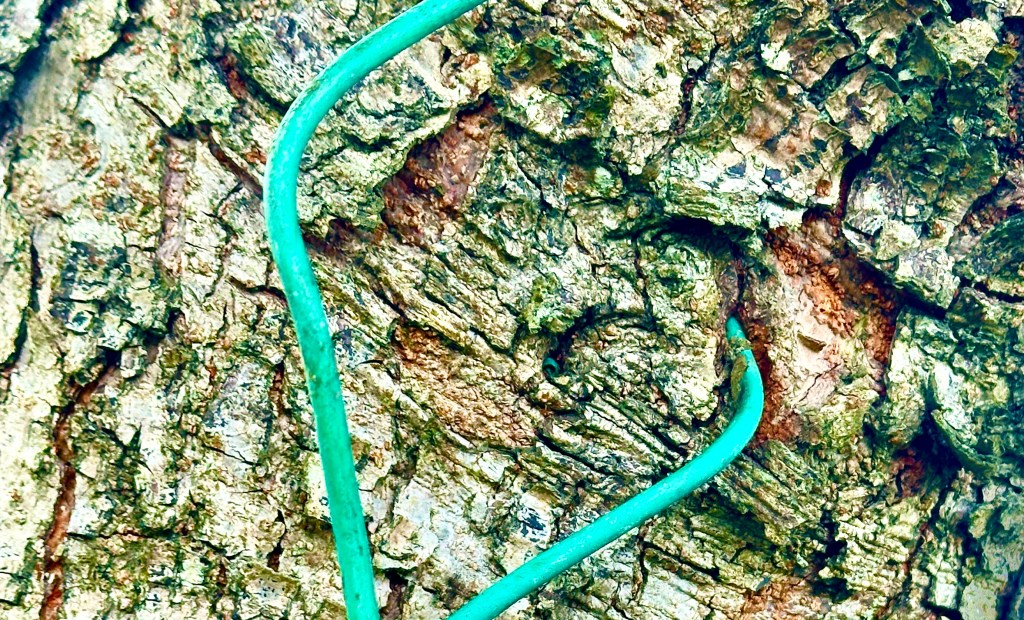
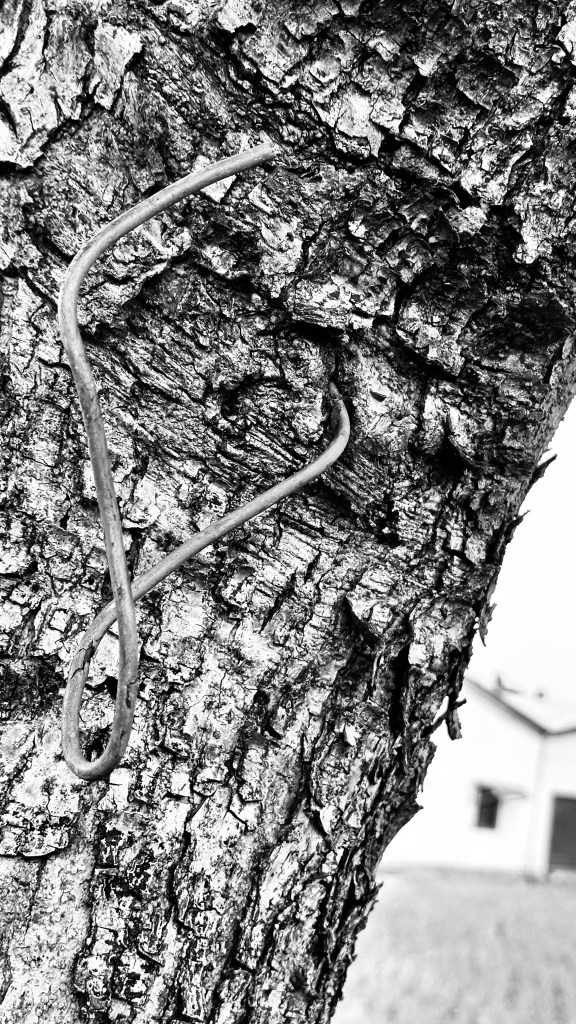
若換成電線,外層包覆著不會腐蝕的塑膠。它的初衷或許同樣是支撐,但它無法消散,無法退場。當樹持續成長,這條線不再是外在的輔助,而是被迫進入內部。樹皮包覆它,將它吞納,卻無法消化。於是,那一圈線,從「在外」變成「在內」,從工具變成異物。
它不再只是附著,而是嵌入。
嵌入,是一種無法撤回的關係。
當時間推動成長,而某些事物沒有隨之轉變,它們就會從支持轉為限制。那條線不再拉住風中的樹,反而在樹的擴張中勒出形狀,留下無法抹滅的印記。它不會消失,只會越來越深。
於是,大樹的表皮出現一道痕跡——
那不是傷口,也不是裝飾,而是一段歷史的凝固。
一個曾經正確、後來錯置的選擇。
我們常以為,所有的支撐都值得保留;
卻忽略了,有些支撐必須被允許消失。
嵌入,本身沒有對錯。
錯的是,把應該消融的,變成永恆;
把暫時的策略,誤當成永久的結構。
當外在的東西無法離開,內在就不得不讓位。
當無法消解的存在被帶入成長的過程,它便從工具轉化為命運。
那條電線,最終成為樹的一部分,卻從未真正屬於它。
而樹,依然向上生長。
“Embedded”
Some forms of support are meant to be temporary.
Beside a young tree not yet steady in its direction, a loop of iron wire is tied by human hands, keeping it from toppling in the wind. At that moment, the wire is not a restraint, but a promise—before strength has formed, it stands in against the world’s shaking. When typhoons arrive, it grips the support firmly, transforming sway into stability, wrapping fragility into something that can endure.
Time moves forward. The sapling becomes a tree. Bark thickens, and growth rings expand outward layer by layer. The iron wire begins to oxidize, its color fading, its structure loosening. It slowly withdraws, like a character that has fulfilled its role, gently erased by time. In the end, it dissolves into the environment, leaving behind not a wound, but the memory of having been protected.
This is a form of embedding that is understood—
to enter, and then to leave;
to support, without possessing;
to shape deeply, without becoming an obstacle.
But not all embeddings are like this.
If instead it were an electrical cable, wrapped in an outer layer of plastic that does not decay, the intention might still be support—but it cannot dissolve, cannot withdraw. As the tree continues to grow, the cable is no longer external assistance; it is forced inward. The bark envelops it, absorbs it, yet cannot digest it. What was once “outside” becomes “inside,” what was once a tool becomes a foreign body.
It no longer merely attaches.
It becomes embedded.
Embedding is a relationship that cannot be undone.
When time drives growth, and something fails to change with it, it shifts from support to constraint. The wire no longer holds the tree against the wind; instead, as the tree expands, it carves into it, leaving an indelible mark. It does not disappear—it only sinks deeper.
And so, upon the surface of the great tree, a trace appears—
not quite a wound, nor an ornament,
but the solidification of a history.
A choice once correct, later misplaced.
We often assume that all forms of support are worth preserving,
yet overlook that some must be allowed to disappear.
Embedding, in itself, is neither right nor wrong.
What goes wrong is turning what should dissolve into permanence,
mistaking a temporary strategy for a lasting structure.
When something external cannot leave, the internal must yield.
When what cannot be resolved is carried into the process of growth, it transforms from a tool into fate.
That cable, in the end, becomes part of the tree—
yet never truly belongs to it.
And the tree continues to grow upward.

 PaliPali
發表留言