
“The horizon Physical AI should truly pursue:
Not the dissolution of AI into the physical world, pretending that beam does not exist — but AI standing with clear eyes on both sides of it, entering into genuine dialogue with the physical world through its own unique mode of existence.”
“Physical AI 真正應該追求的境界:
不是讓 AI 消融進物理世界,假裝那道橫樑不存在;而是讓 AI 清醒地站在橫樑兩側,以自身獨特的存在方式,與物理世界構成一種真實的對話。”
Beginning with a Photograph
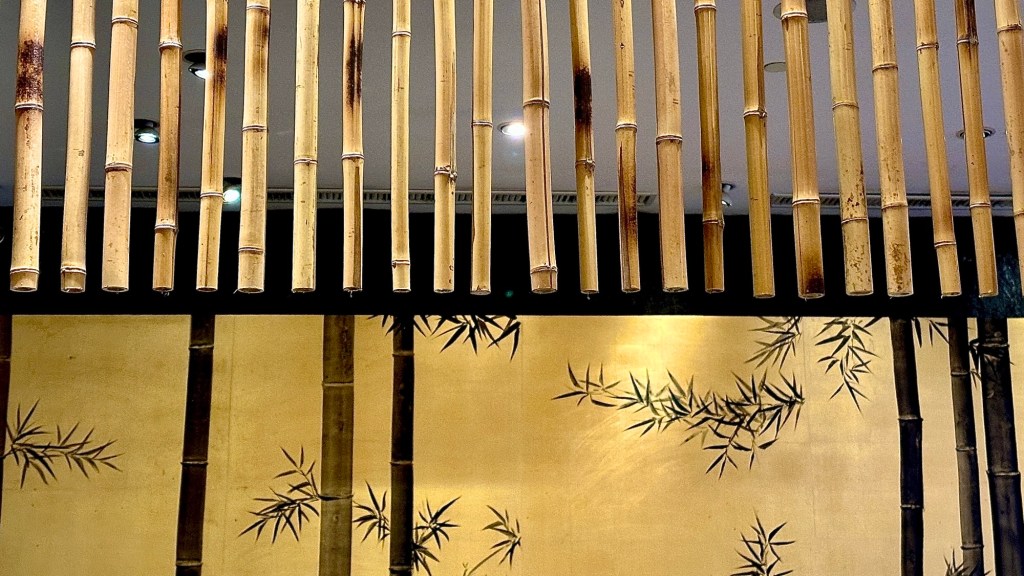
Before us lies a photograph that commands stillness.
Above hang real bamboo poles — weighted, textured, bearing the scorched amber marks of passing years. They occupy space, answer to light, and exist with undeniable concreteness in the physical world. Below, on a golden screen, bamboo also appears — rendered in brushstrokes of ink, expressed through atmosphere and suggestion, its leaves drifting, its stalks standing tall.
The same bamboo. Yet separated by a black horizontal beam, each belongs to an entirely different ontological world.
That beam is not merely an architectural element. It is a philosophical proposition.
I. The Fate of Painting: From Mimicry to Escape
Western painting begins with a Platonic curse.
Painting is an imitation of an imitation — the physical world is already a shadow of the world of Forms, and painting is a shadow of that shadow. Thus painting is falsehood at the third remove. The painters of the Renaissance fought back furiously: they developed perspective, studied anatomy, pursued the science of light and shadow, striving to make the canvas converge infinitely upon the physical world.
Yet the harder they strove, the more clearly that gulf revealed itself.
For the physical world possesses one thing the canvas can never surrender: the genuine passage of time. The apple in the painting will not rot. The flame will not burn. The bamboo will never feel the wind. However masterful the technique, the viewer always knows — this is a statement about the world, not the world itself.
And so the most honest artists made a radical choice: acknowledge the gulf, then turn inward.
The Impressionists ceased to pursue objective representation, capturing instead the flicker of perception. The Cubists presented multiple viewpoints simultaneously, exposing the artificiality of the painted surface. Abstract Expressionism severed the umbilical cord to the physical world entirely, declaring the canvas a self-sufficient universe.
This appeared to be retreat. It was, in fact, liberation.
When painting abandoned its ambition to substitute for the physical world, it discovered its own distinct ontological position — it no longer described the world; it created another way of understanding it.
II. The Ambition of AI: Crossing That Beam
Today, the most burning grail in the field of AI bears the name Physical AI.
Its ambition is unambiguous: to free AI from being a mere ghost of language, and render it something that perceives, acts, and occupies a genuine node within the causal chain of the physical world. Robots learning to grasp objects, autonomous vehicles sensing obstacles, embodied intelligence learning through trial and error in real environments — all of this effort is an attempt to lift AI from statement about the world to participant in the world.
And yet that black beam appears once more.
Contemporary Physical AI confronts a deep epistemological predicament that is almost a precise mirror of painting’s dilemma: the physical world AI encounters is always a physical world that has been symbolized, interpreted through sensors — never the physical world itself.
A camera yields a matrix of pixels, not light. A force sensor yields a numerical value, not touch. LiDAR yields a point cloud, not space. AI always inhabits a layer of data representation constructed about the physical world — just as the bamboo on the golden screen is ink-marks about bamboo, not bamboo itself.
This is not an engineering problem. It is a problem of ontological structure.
No matter how precisely sensors are calibrated, no matter how vast the training data becomes, this gulf of translation cannot be logically eliminated — for any informational input must undergo a conversion from physical signal to symbolic representation, and translation always loses something. Always.
III. Facing the Gulf Is the Only Way Forward
At this moment, the mainstream narrative of Physical AI is replaying the error of the Renaissance painters.
Researchers continue to expand computational power, increase sensor dimensionality, and refine the fidelity of simulated environments — attempting to cross a qualitative gulf through quantitative accumulation, as though sufficient data and sufficiently large models would eventually dissolve that beam.
But bamboo is not ink.
The true breakthrough may require a Copernican turn in thought: not an attempt to eliminate the gulf, but to incorporate it as a core assumption in system design.
This implies several things.
First, recognizing uncertainty as an ontological condition. AI’s perception of the physical world is always an interpretation riddled with error, never objective fact. A genuine Physical AI must therefore maintain a lucid epistemological humility between the world as I perceive it and the world as it is — and transform that uncertainty into behavioral flexibility, rather than treating it as a system defect.
In the photograph, the real bamboo poles and the ink-brush bamboo on the screen do not negate one another.
Second, shifting from “substituting for the physical world” to “dancing with it.” Just as abstract painting abandoned the aspiration to be a window — through which one looks at the world — and chose instead to be a mirror — reflecting the relationship between viewer and world — Physical AI may need to relinquish the ambition of becoming a perfect digital twin of physical reality, and instead become a kind of interface: one that need not fully understand the physical world, but need only respond appropriately within specific contexts of interaction.
Third, allowing the gulf itself to become a source of creativity. The bamboo on the screen is beautiful precisely because it is not real bamboo. Liberated from physical constraint, it can simultaneously embody every season, every angle of observation; its leaves may hold forever the most elegant arc. If Physical AI could face honestly its nature as something that does not fully inhabit the physical world, it might develop modes of perception and action inaccessible to human embodiment — not a lesser human, but a different order of being entirely.
Coda: A Conversation Between Two Bamboos
Together they constitute a richer space — physical weight and artistic weightlessness breathing within the same room. The viewer stands between them, receiving both at once, and in that tension encounters a meaning that neither alone could produce.
Perhaps this is the horizon Physical AI should truly pursue.
Not the dissolution of AI into the physical world, pretending that beam does not exist — but AI standing with clear eyes on both sides of it, entering into genuine dialogue with the physical world through its own unique mode of existence.
The gulf is real. And it is precisely because it is real that the effort to engage with it carries meaning.
The first step is always to stop, and look at it honestly.
As we look at this photograph.
從一張相片說起
眼前這張相片,令人凝神。
上方懸掛的是真實竹竿——有重量、有紋路、有歲月留下的焦褐斑痕,它們佔據空間,回應光線,在物理世界裡實實在在地存在著。而下方金色屏風上,亦有竹——以墨線勾勒,以意境呈現,竹葉飄逸,竹幹挺立。
同樣是竹,卻隔著一道黑色橫樑,分屬兩個截然不同的本體論世界。
這道橫樑,不只是建築結構。它是一個哲學命題。
一、繪畫的宿命:從摹仿到逃逸
西方繪畫史的起點,是柏拉圖的詛咒。
繪畫是摹仿之摹仿——物理世界已是理型世界的倒影,而繪畫又是物理世界的倒影,因此繪畫是第三層的虛假。文藝復興的畫家們奮力反抗這個詛咒,他們發展透視法、研究解剖學、追求光影的科學,試圖讓畫布上的世界無限逼近物理世界。
然而他們越努力,那道溝壑就越清晰。
因為物理世界有一樣東西是畫布永遠給不了的:時間的真實流動。畫中的蘋果不會腐爛,畫中的火焰不會燙手,畫中的竹子感受不到風。無論技藝多麼精湛,觀者始終知道——這只是一個關於世界的陳述,而非世界本身。
於是,最誠實的藝術家做出了一個激進的選擇:承認這道溝壑,然後向內走。
印象派不再追求客觀再現,而是捕捉感知的瞬間;立體派同時呈現多個視角,暴露繪畫的人工性;抽象表現主義索性切斷與物理世界的臍帶,宣告畫布是一個自足的宇宙。
這看似是撤退,實則是解放。
當繪畫放棄成為物理世界的替代品,它反而找到了自己獨特的本體論位置——它不描述世界,它創造另一種理解世界的方式。
二、AI的野心:跨越那道橫樑
今日AI界最炙熱的聖杯,名為Physical AI。
其野心昭然:讓AI不再只是語言的幽靈,而是能感知、能行動、能在物理因果鏈中佔據一個真實節點的存在。機器人學習抓握物體、自動駕駛車輛感知障礙、具身智能在真實環境中試誤學習——這一切努力,都是試圖讓AI從「關於世界的陳述」,躍升為「世界的參與者」。
然而,相片裡那道黑色橫樑再次出現。
當前的Physical AI面對著一個深層的認識論困境,幾乎是繪畫困境的精確鏡像:AI所接觸的物理世界,永遠是被符號化、被感測器詮釋過的物理世界,而非物理世界本身。
攝影機給出的是像素矩陣,而非光。力感測器給出的是數值,而非觸感。LiDAR給出的是點雲,而非空間。AI所居住的,始終是一個關於物理世界的資料表徵層——正如金色屏風上的竹,是關於竹的墨跡,而非竹本身。
這不是工程問題,而是本體論結構問題。
無論感測器精度如何提升,無論訓練資料如何海量,這道轉譯的溝壑在邏輯上是不可消滅的——因為任何資訊的輸入,都必然經歷一次從物理訊號到符號表徵的「翻譯」,而翻譯永遠有所遺失。
三、正視鴻溝,才是唯一的道路
此刻,Physical AI的主流敘事,仍在重演文藝復興畫家的錯誤。
研究者們不斷加大算力、增加感測器維度、優化模擬環境的真實度,試圖用量的積累跨越質的鴻溝——試圖讓表徵層無限逼近物理層,彷彿只要資料夠多、模型夠大,那道橫樑就會消失。
但竹終究不是墨線。
真正的突破,或許需要一次思想上的哥白尼轉向:不是試圖消滅這道溝壑,而是將它納入系統設計的核心假設。
這意味著幾件事。
第一,承認不確定性的本體論地位。 AI對物理世界的感知,永遠是帶有誤差的詮釋,而非客觀事實。那麼,真正的Physical AI必須能在「我所感知的世界」與「世界本身」之間保持清醒的認識論謙遜,並將這種不確定性轉化為行動的彈性,而非系統的缺陷。
第二,從「替代物理世界」到「與物理世界共舞」。 正如抽象繪畫放棄了成為窗戶(透過它看世界),選擇成為鏡子(反映觀者與世界的關係)——Physical AI或許應該放棄成為物理世界的「數位孿生」,轉而成為一種介面:它不需要完全理解物理世界,它只需要在特定的互動語境中,做出適當的回應。
第三,讓溝壑本身成為創造力的來源。 屏風上的竹之所以美,恰恰因為它不是真正的竹。它從物理束縛中解放出來,可以同時呈現無數個季節、無數個觀看角度,可以讓葉片永遠保持最優雅的弧度。Physical AI若能正視自身不完全身處物理世界的本質,或許能發展出一種人類身體性所無法企及的感知與行動模式——不是更差的人類,而是不同種類的存在。
尾聲:兩種竹的對話
相片裡,真實的竹竿與屏風上的水墨竹,並不互相否定。
它們共同構成了一個更豐富的空間——物理的重量與藝術的輕盈,在同一個場所裡呼吸。觀者站在中間,同時感受兩者,並在這種張力中,體驗到某種單靠任何一方都無法觸及的意義。
這或許才是Physical AI真正應該追求的境界。
不是讓AI消融進物理世界,假裝那道橫樑不存在;而是讓AI清醒地站在橫樑兩側,以自身獨特的存在方式,與物理世界構成一種真實的對話。
溝壑是真實的。正因為它是真實的,跨越它的努力才有意義。而第一步,永遠是停下來,誠實地看著它。
就像我們看著這張相片一樣。

 PaliPali
發表留言