

Abstract
With the rapid development of Artificial Intelligence (AI), many global business leaders and researchers emphasize “First-Principles Thinking" as a core methodology for innovation. This paper uses the thermal design of AI devices as a case study to illustrate how First-Principles Thinking can be systematically applied to engineering practice.
The escalating computing density and power consumption of current Large Language Models (LLMs) have made thermal design a critical factor affecting overall system performance and reliability. This paper proposes a systematic innovation framework spanning the physical, control, and statistical layers. It demonstrates how to translate theoretical innovation into engineering practice through three progressive systematic steps:
- The Fundamental Principles of Heat Dissipation and the Development of Active/Passive Approaches — Applying the TRIZ Innovation Methodology
- Entropy Increase and the Dynamic Management of Thermal Zones — Based on the ACPI Thermal Management Architecture
- Probability Theory and Simulation Model Construction — Applying Bayes’ Theorem
摘要
隨著人工智慧(AI)高速發展,多位世界領導地位的企業家與研究員強調在創新發展中以「第一原理思維(First-Principles Thinking)」為核心方法。本文以AI裝置散熱設計為案例,說明如何將第一原理思維系統化地應用於工程實踐。
當前大型語言模型(LLM)運算密度與功率消耗劇增,散熱設計已成為影響整體系統效能與可靠性的關鍵因素。本文提出一個跨越物理、控制與統計層面的系統化創新框架,通過三個遞進的系統步驟,展示如何將理論創新轉化為工程實踐:
- 散熱的基本原理與主動被動發展 — 運用TRIZ創新方法論
- 熵增與熱區域的動態驅動 — 基於ACPI熱管理架構
- 概率論與模擬模型建構 — 應用貝葉斯定理(Bayes’ Theorem)
I. The Fundamental Principles of Heat Dissipation and the Development of Active/Passive Approaches — TRIZ Innovation Methodology
1.1 The Fundamental Physical Principles of Heat Dissipation
The core of heat dissipation is to utilize three modes of heat transfer to move the heat generated by heating components (e.g., CPU/GPU) from a high-temperature region to the environment, thereby lowering the component temperature and ensuring its normal operation. These three modes of heat transfer include:
1.1.1 Conduction
- Principle: Heat is transferred from a high-temperature object to a low-temperature object when the two substances are in direct contact.
- Application: Heat generated by electronic components is first transferred through a thermally conductive material (e.g., thermal paste) to the base of the heatsink. The heatsink is made of highly conductive materials (e.g., aluminum, copper) to rapidly conduct heat to the entire fin array.
1.1.2 Convection
- Principle: Heat is transferred through the movement of a fluid (air or liquid). The heated fluid becomes less dense and rises, while the cooler fluid becomes denser and sinks, creating a cycle.
- Application:
- Natural Convection: Heated air naturally rises, and cooler air flows in to replace it, carrying heat away.
- Forced Convection: A fan blows cool air over the heatsink, accelerating the transfer of heat from the heatsink surface to the air.
1.1.3 Radiation
- Principle: Objects emit heat via electromagnetic waves (infrared), transferring thermal energy to the environment.
- Application: The surface of the heatsink emits infrared radiation, dissipating heat to the surrounding environment, further assisting in cooling.
1.2 Innovation Matrix: TRIZ Analysis of Active and Passive Cooling
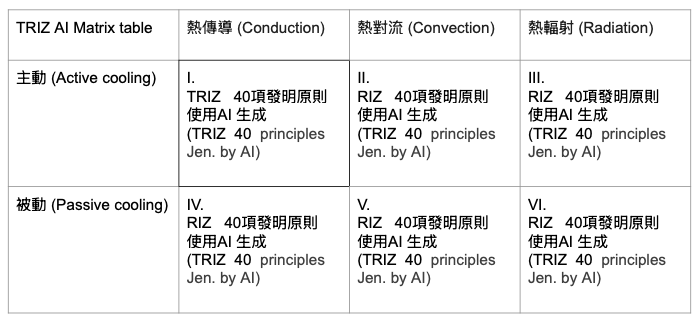
Based on the fundamental principles of heat dissipation, an innovation matrix can be developed by combining the concepts of active and passive cooling. Across the six quadrants of this matrix, we use the essence of each quadrant as a parametric basis. By leveraging AI in conjunction with the 40 Inventive Principles of TRIZ (Teoriya Resheniya Izobreatatelskikh Zadatch, the Theory of Inventive Problem Solving) proposed by the Soviet inventor Genrich Altshuller, we can generate the highest-probability directions for innovative development.
1.3 In-Depth Analysis of High-Potential Development Directions
The following TRIZ principles are selected as representative and high-potential based on the innovation matrix:
1.3.1 Principle 15 “Dynamization": The Inevitable Trend for Heat Dissipation
Application Scenarios:
- Passive Cooling → Adjustable Structure: Deformable heatsink fins (e.g., biomimetic pinecone scales that open and close with temperature).
- Active Cooling → Smart Speed Regulation: AI load prediction combined with adaptive fan control and VRM (Voltage Regulator Module) cooling.
Potential Analysis: Most current thermal designs adopt a “design for worst-case scenario" strategy, leading to wasted power or space most of the time. If the cooling structure itself can dynamically change its effective area, airflow path, or heat conduction path, cooling efficiency can increase by 30%–50%, while power consumption drops by 5%–20%.
1.3.2 Principle 10 “Preliminary Action": From Reactive to Predictive Cooling
Conceptual Shift: “Dissipate heat after it gets hot" → “Dissipate heat before it gets hot"
Application Examples:
| Type | Example | Application Scenario |
|---|---|---|
| Heat Absorption Material | PCM (Phase Change Material) + Phase-Change Layer for initial cold storage | Server / Electric Vehicle Thermal Buffering Mechanism |
| AI Thermal Model | Accelerate fan speed before a high load is predicted | Gaming SoC / Edge AI |
Potential Analysis: This strategy prevents instantaneous overheating that triggers Thermal Throttling, which is especially crucial in peak-power devices like CPUs, GPUs, and Electric Vehicle inverters.
1.3.3 Principle 28 “Replacement of a Mechanical System": Fan-less ≠ Active Cooling-less
Novel Technologies:
| Type | Technology | Advantage |
|---|---|---|
| Piezoelectric Fan / Electrostatic Wind | Ion wind, Electrohydrodynamic | No noise, no wear |
| Microchannel / Capillary Circulation | Loop heat pipe / Vapor chamber | Passive + Active Hybrid Mode |
Potential Analysis: These technologies could disrupt the current “fan-dominated active cooling" landscape, enabling heat dissipation to overcome bottlenecks related to noise, volume, and reliability.
1.3.4 Principle 22 “Turning the Harm into a Benefit": Waste Heat as a Resource
Waste Heat Recovery Applications:
| Waste Heat Use | Technology | Commercial Application |
|---|---|---|
| Thermoelectric Recovery | TE Module (Reverse Peltier effect for power generation) | IoT self-powering, Vehicle energy recovery |
| Flow-Guiding to Boost Cool Air | Chimney Effect Design | Improved convection efficiency without extra power |
Potential Analysis: If the CPU/GPU thermal power is >5W, a portion of the energy can be recovered to power sensors or fans, realizing a truly self-circulating cooling system.
1.4 Summary
The TRIZ thermal structure analysis, assisted by AI, can derive multiple potential development directions. While some directions may already be pursued by companies, this demonstrates the generative capability of First-Principles Thinking combined with systematic innovation tools. Practical application still requires further in-depth exploration and validation.
II. Entropy Increase and the Dynamic Management of Thermal Zones — ACPI Thermal Management Architecture
2.1 The Principle of Entropy Increase and Cooling Systems
2.1.1 The Law of Entropy Increase
“Entropy Increase" refers to the natural tendency for the degree of disorder (entropy) in an isolated system to increase over time, moving the system from an ordered to a disordered state. This concept stems from the Second Law of Thermodynamics:
- Isolated System: The law applies to systems that do not exchange energy or matter with the outside environment.
- Natural Trend: In an isolated system, all spontaneous processes lead to an increase in total entropy; this process is irreversible.
- Energy Degradation: Entropy increase signifies that in the process of energy conversion, a portion of the energy is converted into energy unavailable to do work, leading to a decrease in the system’s capacity to do work.
Significance in a Cooling System: According to the Law of Entropy Increase, the total entropy of a closed system will only increase or remain constant without external intervention; it will never decrease. This means a cooling system must have active or passive mechanisms to counteract the increase in entropy and maintain the system’s orderly operation.
2.2 The Concept of ACPI Thermal Zones
The “Thermal Zone" is a core concept in the system thermal management framework, explicitly defined in the Advanced Configuration and Power Interface (ACPI) specification.
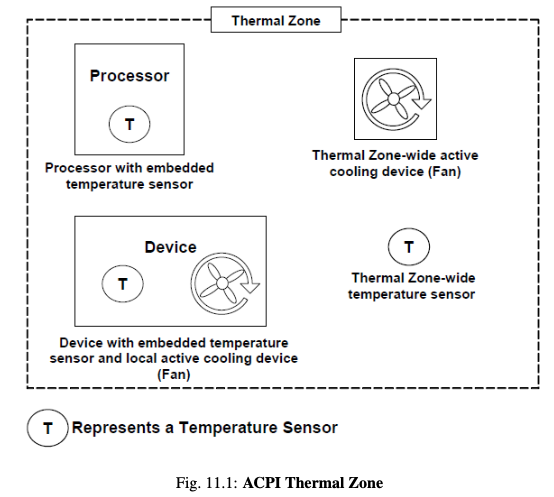
Copy from “Advanced Configuration and Power Interface (ACPI) Specification Release 6.5″
2.2.1 Core Definition of a Thermal Zone
- Logical Partition: A Thermal Zone is a logical area partitioning the system or specific parts of the system, such as the CPU, GPU, or memory.
- Physical Composition: Physically, it includes devices used to control temperature, thermal sensors, and cooling control components.
- Thermal Management Foundation: It is the foundational concept upon which the ACPI thermal management model is built, allowing the Operating System Power Management (OSPM) to proactively execute cooling policies at the system level.
- Flexible Design: Although the entire PC is often treated as one large Thermal Zone, Original Equipment Manufacturers (OEMs) can divide the system into several logical Thermal Zones to achieve optimized thermal control in complex systems.
2.2.2 Key Components within a Thermal Zone (ACPI Thermal Objects)
A Thermal Zone is a collection of objects in the ACPI namespace that provide information and control interfaces for that zone. Key thermal objects include:
Temperature Sensing and Reporting:
- _TMP (Temperature): Reports the current temperature of the Thermal Zone (in tenths of a degree Kelvin).
- _TSN (Thermal Sensor Device): Returns a reference to the thermal sensor device used to monitor the temperature of the Thermal Zone.
Cooling Control Trip Points:
- _ACx (Active Cooling Trip Point): Defines the critical temperature threshold for active cooling, e.g., to activate a fan.
- _PSV (Passive Cooling Trip Point): Defines the critical temperature threshold for passive cooling, e.g., to lower the processor clock speed (throttling) to reduce temperature.
- _CRT (Critical Temperature): Defines the critical temperature threshold, upon reaching which the OSPM must perform an emergency shutdown.
- _HOT (Hot Temperature): Defines a critical temperature threshold, upon reaching which the OSPM may choose to transition the system to the S4 sleep state.
- _CR3 (Warm/Standby Temperature): Defines a critical temperature threshold, upon reaching which the OSPM may choose to transition the system to a lower power state such as S3 or S0 Idle.
Cooling Device Lists and Properties:
- _ALx (Active Cooling List): Lists the Active Cooling Device objects (e.g., fans) that should be activated when the corresponding _ACx temperature threshold is exceeded.
- _PSL (Passive Cooling List): Lists the processor objects used to perform passive cooling.
- _TZD (Thermal Zone Devices): Evaluates to a list of device names associated with the Thermal Zone.
- _TRT (Thermal Relationship Table): Evaluates to a package that describes the thermal relationships between devices within the Thermal Zone.
Passive Cooling Constants:
- _TC1 and _TC2 (Thermal Constant): Constants used in the passive cooling formula for OSPM to evaluate the required processor performance change.
- _TSP or _TFP (Thermal Sampling Period): Defines the period at which the OSPM should sample the hardware temperature (_TSP is in tenths of a second, _TFP is in milliseconds, and _TFP takes precedence).
2.3 Cooling Modes: The Dynamic Balance of Active and Passive
When the temperature reaches or exceeds a set trip point, the OSPM executes one of the following two primary cooling modes:
2.3.1 Active Cooling
- Mechanism: The OSPM takes direct action, such as turning on a fan, to cool the zone by removing heat.
- Characteristics: Typically increases power consumption and noise but maintains system performance.
- Applicable Scenarios: High-performance computing, gaming, AI training, and other scenarios requiring maximum computing power.
2.3.2 Passive Cooling
- Mechanism: The OSPM reduces the temperature of the Thermal Zone by lowering the device’s power consumption (e.g., limiting processor clock speed or performance).
- Characteristics: Typically produces no noise but sacrifices system performance.
- Applicable Scenarios: Light-load computing, extended battery life, noise-sensitive requirements, etc.
2.4 System Architecture for Dynamic Thermal Management
Based on the Principle of Entropy Increase and the ACPI Thermal Zone concept, modern cooling systems adopt a dynamic adjustment architecture:
- Real-Time Monitoring: Continuously monitor the temperature of each Thermal Zone via _TMP.
- Threshold Comparison: Compare the current temperature with various Trip Points (_ACx, _PSV, _CRT, etc.).
- Policy Selection: Dynamically switch between active and passive cooling based on the temperature level.
- Execution and Regulation: Activate the corresponding cooling device (_ALx) or adjust processor performance (_PSL).
- Cyclic Optimization: Continuously monitor and adjust based on the sampling period defined by _TSP/_TFP.
Dynamic Balance Strategy:
Modern thermal management systems employ a hybrid strategy, dynamically adjusting the ratio of active to passive cooling based on workload, ambient temperature, and user preference, seeking the optimal balance among performance, power consumption, and noise.
2.5 Summary
The ACPI thermal management framework provides a standardized, scalable control architecture that enables the operating system to dynamically adjust cooling strategies based on real-time temperature information. This control layer design is the crucial bridge that translates the physical principles of heat dissipation into system-level practice.
III. Probability Theory and Simulation Model Construction — Bayes’ Theorem
3.1 Thermal Model Construction and Simulation
Thermal model building and simulation involve creating a virtual thermal model using software and predicting its thermal transfer behavior under various conditions. This process includes building a model that incorporates heat sources, materials, geometry, and fluid, followed by simulation analysis using different numerical methods.
3.1.1 Model Construction Workflow
Engineers first abstract the real system to create a virtual model in software, including the following elements:
- Heat Source: Computing chips like CPU/GPU.
- Conductive Materials: Thermal paste, heat pipes, heatsinks, etc.
- Geometric Structure: Heatsink shape, fin configuration, airflow path design.
- Convective Fluid: Air or liquid cooling medium.
3.1.2 Numerical Analysis Methods
Thermal transfer behavior is simulated using the following numerical analysis methods:
- Finite Element Method (FEM): Discretizes the continuous physical domain into a finite number of small elements, suitable for complex geometries.
- Finite Difference Method (FDM): Discretizes partial differential equations into difference equations, offering high computational efficiency.
- Thermal Network Model (TNM): Analogizes the thermal system to an electrical circuit network, providing quick estimation of thermal resistance and temperature distribution.
These simulations can predict the temperature distribution, heat flux density, and thermal resistance paths under different power levels, ambient temperatures, and airflow conditions, helping designers pre-evaluate potential thermal risks before manufacturing samples.
3.2 From Simulation to Reality: The Dynamic Correction Loop
3.2.1 The Existence of Model Error
Even the most precise model is subject to error. When actual samples are tested, results often deviate from simulated values, such as:
- Local Hot Spots: Areas of heat concentration not accurately predicted by the model.
- Boundary Condition Errors: Discrepancies between the actual environment and the simulation assumptions.
- Material Parameter Deviations: Differences between the actual material properties and the database values.
3.2.2 The Closed-Loop Calibration Process
Engineers feed measurement results back to the model to adjust parameters:
- Correction of material thermal conductivity.
- Re-evaluation of interface thermal resistance.
- Optimization of contact conditions.
This is a dynamic, closed-loop process of “Theoretical Prediction → Experimental Verification → Model Correction → New Round of Prediction." This cycle is essentially a statistical inference problem, the mathematical foundation of which is Bayes’ Theorem.
3.3 Bayes’ Theorem and Model Calibration
3.3.1 The Mathematical Form of Bayes’ Theorem
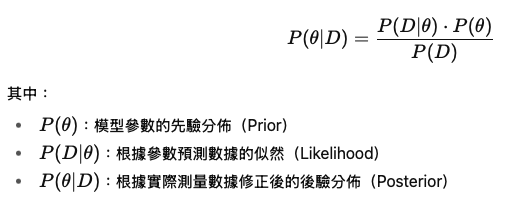
Bayes’ Theorem provides a method to dynamically update our belief in system parameters based on new data. Its mathematical form is:
3.3.2 Application in Thermal Models
In the context of thermal models, the application of Bayes’ Theorem can be understood as follows:
- Prior Distribution ($\text{Prior}$): Represents the initial model assumptions set by the engineer based on experience.
- Example: Initial estimated value for material thermal conductivity, default parameters for airflow conditions.
- Likelihood Function ($\text{Likelihood}$): Represents how well the model simulation results match the actual measured data.
- Example: The distribution of the deviation between simulated and measured temperatures.
- Posterior Distribution ($\text{Posterior}$): Reflects how the model parameters should be updated after observing the results from the actual sample.
- Example: The corrected material thermal conductivity that makes the simulation closer to the measured results.
This iterative correction process allows the model to continuously learn and evolve, ultimately achieving high-fidelity thermal prediction capability.
3.4 Probabilistic Thinking in Engineering Simulation
3.4.1 Uncertainty Quantification (UQ)
Traditional engineering simulations often assume fixed conditions and deterministic inputs; however, all design parameters have uncertainty in the real world. Bayesian theory introduces the concept of “Uncertainty Quantification," making the simulation result not just a single value but a probability distribution that reflects the Robustness of the design under varying conditions.
3.4.2 From Deterministic to Probabilistic
Thermal simulation is no longer just “a set of results" but a “probability field":
- Temperature Distribution: Not a single value but a distribution with a confidence interval.
- Thermal Risk Assessment: The probability of exceeding critical temperature can be quantified.
- Design Robustness: Assessment of the design’s reliability under parameter variation.
This provides decision-makers with higher confidence and basis when making choices on material selection, structural design, or cost trade-offs.
3.5 From Thermal Simulation to Intelligent Design
3.5.1 The Integration of AI and Machine Learning
As Artificial Intelligence (AI) and Machine Learning (ML) integrate into the engineering simulation domain, the Bayesian approach becomes the foundation for “Intelligent Design." Through the following techniques, the system can automatically find the optimal combination of design parameters based on a limited number of simulations and experiments:
- Bayesian Optimization: Efficiently searches for the optimal solution in the design space.
- Gaussian Process Regression: Establishes a probabilistic mapping relationship between parameters and performance.
These methods significantly shorten the development cycle and enhance cooling efficiency.
3.5.2 The Future of Adaptive Systems
Future thermal models will not only be passive predictors but also adaptive systems capable of active learning and adjustment:
- Real-Time Learning: Continuously collect data and update the model during system operation.
- Predictive Maintenance: Predict potential thermal failures based on historical data.
- Dynamic Optimization: Adjust the cooling strategy in real-time based on actual load and environmental conditions.
This development is a revolution in thinking, rooted in probability theory.
IV. Conclusion: The Innovation Closed-Loop from Physics to Intelligence
4.1 Systematic Integration with a Three-Layer Architecture
Starting with first principles, this paper constructs a cross-layer system for cooling innovation:
- Conceptual Layer
- Understanding the three physical principles of heat transfer (Conduction, Convection, Radiation).
- Using TRIZ to explore the design space and generate innovative directions.
- Establishing an innovation matrix for active and passive cooling.
- System Layer
- Applying the Principle of Entropy Increase to understand the system’s natural tendency.
- Utilizing the ACPI Thermal Zone concept to realize dynamic thermal management.
- Achieving a balance between active and passive cooling.
- Inference Layer
- Calibrating and optimizing the model with Bayes’ Theorem.
- Introducing Uncertainty Quantification, shifting from deterministic derivation to probabilistic learning.
- Realizing continuous learning and adaptive optimization of the model.
4.2 A Practical Example of First-Principles Thinking
This framework is not only a new mindset for thermal design but also a practical example of first principles in AI engineering innovation:
- Starting from Fundamental Principles: Not limited by existing solutions, but returning to the physical essence for ideation.
- Systematic Innovation: Using tools like TRIZ to convert intuition into structured methods.
- Dynamic Adjustment and Learning: Implementing continuous optimization through ACPI and Bayesian methods.
- Interdisciplinary Integration: Combining physics, control, statistics, and AI to form a complete innovation closed-loop.
4.3 Outlook and Application Potential
Starting from the fundamental principles of heat dissipation, combined with the concepts of active and passive cooling, an innovation matrix is developed. Across the six quadrants of this matrix, using the essence of each quadrant as a parametric basis, AI-generated results are used to select representative and high-potential TRIZ principles.
Furthermore, based on the Principle of Entropy Increase and the Second Law of Thermodynamics, under the premise that the total entropy of a closed system will only increase or remain constant, the core concept of the “Thermal Zone" system thermal management framework is utilized within the ACPI (Advanced Configuration and Power Interface) specification. Through the explicit definitions of active and passive cooling, the system dynamically adjusts to reduce the temperature of the thermal zone, achieving a balance between noise control and system performance.
Finally, the iterative correction of thermal simulation, leading to AI-assisted model optimization, is underpinned by the core idea of statistics—Bayes’ Theorem. It shifts engineering simulation from “deterministic derivation" to “probabilistic learning," enabling the model to constantly absorb new information and approximate the complex behavior of the real world.
This marks not only a turning point for engineering simulation but also a crucial foundation for moving towards intelligent design, demonstrating the systematic application and limitless potential of First-Principles Thinking in innovation.
References
(The references remain in the original English titles as provided.)
First Principles Thinking and Innovation Methodology
- Altshuller, G. (1999). The Innovation Algorithm: TRIZ, Systematic Innovation and Technical Creativity. Technical Innovation Center.
- Altshuller, G. (1984). Creativity as an Exact Science: The Theory of the Solution of Inventive Problems. Gordon and Breach Science Publishers.
- Musk, E. (2013). “First Principles Thinking". Interview with Kevin Rose.
Thermodynamics and Heat Dissipation Principles
- Incropera, F. P., DeWitt, D. P., Bergman, T. L., & Lavine, A. S. (2011). Fundamentals of Heat and Mass Transfer (7th ed.). Wiley.
- Cengel, Y. A., & Ghajar, A. J. (2014). Heat and Mass Transfer: Fundamentals and Applications (5th ed.). McGraw-Hill Education.
- Clausius, R. (1865). “The Mechanical Theory of Heat – with its Applications to the Steam Engine and to Physical Properties of Bodies". Annalen der Physik.
ACPI Specification and Thermal Management
- ACPI Specification Working Group. (2021). Advanced Configuration and Power Interface (ACPI) Specification, Version 6.4. Unified Extensible Firmware Interface Forum. Retrieved from https://uefi.org/specifications
- Hewlett-Packard Corporation, Intel Corporation, Microsoft Corporation, Phoenix Technologies Ltd., & Toshiba Corporation. (2019). ACPI Thermal Management White Paper.
Bayesian Statistics and Uncertainty Quantification
- Bayes, T., & Price, R. (1763). “An Essay towards solving a Problem in the Doctrine of Chances". Philosophical Transactions of the Royal Society of London, 53, 370-418.
- Gelman, A., Carlin, J. B., Stern, H. S., Dunson, D. B., Vehtari, A., & Rubin, D. B. (2013). Bayesian Data Analysis (3rd ed.). CRC Press.
- Smith, R. C. (2013). Uncertainty Quantification: Theory, Implementation, and Applications. SIAM.
Computational Heat Transfer and Fluid Dynamics and Simulation
- Patankar, S. V. (1980). Numerical Heat Transfer and Fluid Flow. CRC Press.
- Versteeg, H. K., & Malalasekera, W. (2007). An Introduction to Computational Fluid Dynamics: The Finite Volume Method (2nd ed.). Pearson Education.
- Rasmussen, C. E., & Williams, C. K. I. (2006). Gaussian Processes for Machine Learning. MIT Press.
AI-Assisted Engineering Design
- Shahriari, B., Swersky, K., Wang, Z., Adams, R. P., & de Freitas, N. (2016). “Taking the Human Out of the Loop: A Review of Bayesian Optimization". Proceedings of the IEEE, 104(1), 148-175.
一、散熱的基本原理與主動被動發展 — TRIZ創新方法論
1.1 散熱的基本物理原理
散熱的核心是利用三種熱量傳遞方式,將發熱元件(如CPU/GPU)產生的熱量從高溫區域傳遞至環境,從而降低元件溫度並保護其正常運行。這三種熱傳遞方式包括:
1.1.1 熱傳導(Conduction)
- 原理:當兩個物質直接接觸時,熱量從高溫物體傳遞到低溫物體
- 應用:電子元件產生的熱量首先通過導熱材料(如散熱膏)傳遞到散熱器底部。散熱器由導熱性佳的材料(如鋁、銅)製成,能快速將熱量傳導到整個散熱片
1.1.2 熱對流(Convection)
- 原理:熱量通過流體(空氣或液體)的運動來傳遞。加熱的流體密度減小而上升,冷卻的流體密度增大而下降,形成循環
- 應用:
- 自然對流:加熱的空氣自然上升,冷空氣流動補充,帶走熱量
- 強制對流:風扇將冷空氣吹過散熱器,加速熱量從散熱器表面轉移到空氣中
1.1.3 熱輻射(Radiation)
- 原理:物體透過電磁波(紅外線)發出熱量,將熱能傳遞至環境
- 應用:散熱器表面發射紅外線,將熱量輻射到周圍環境,進一步協助散熱
1.2 創新矩陣:主動與被動散熱的TRIZ分析
基於散熱的基本原理,結合主動與被動的概念,可以發展出創新矩陣。在創新矩陣交錯的六個象限中,我們以各象限的內涵為參數基礎,運用AI結合前蘇聯發明家根里奇·阿奇舒勒(Genrich Altshuller)提出的TRIZ(Teoriya Resheniya Izobreatatelskikh Zadatch,創造性問題解決理論)40項發明原則,生成最高機率的創新發展方向。
1.3 高潛力發展方向深度分析
以下是依據創新矩陣挑選出具代表性與高發展性的TRIZ原則:
1.3.1 原則15「動態化」:散熱的必然趨勢
應用場景:
- 被動散熱 → 可調結構:可變形散熱鰭片(如仿生松果鱗片,隨溫度張開閉合)
- 主動散熱 → 智慧調速:AI負載預測結合自適應風扇控制與VRM(電壓調節模組)冷卻
潛力分析: 現今散熱設計大多採用「為最壞情況設計」的策略,導致大部分時間浪費能耗或空間。若散熱結構本身可動態改變有效面積、風道或導熱路徑,散熱效率可提升30%~50%,並降低5%~20%的功耗。
1.3.2 原則10「預先作用」:從反應式到預測式散熱
概念轉變:「熱了再散」→「快熱之前就先散」
應用實例:
| 類型 | 實例 | 應用場景 |
|---|---|---|
| 吸熱材料 | PCM(相變材料)+ 相變層先蓄冷 | 伺服器 / 電動車熱緩衝機制 |
| AI散熱模型 | 預測高負載前先加速風扇 | Gaming SoC / Edge AI |
潛力分析: 此策略可避免瞬間過熱引發熱降頻(Thermal Throttling),在CPU/GPU/電動車逆變器等高峰值裝置中特別關鍵。
1.3.3 原則28「代用機械系統」:無風扇 ≠ 無主動散熱
新型技術:
| 類型 | 技術 | 優勢 |
|---|---|---|
| 壓電風/靜電風 | Ion wind, Electrohydrodynamic | 無噪音、無磨耗 |
| 微流道/毛細循環 | Loop heat pipe / Vapor chamber | 被動+主動混合模式 |
潛力分析: 這類技術可能顛覆現有「風扇主宰主動散熱」的格局,讓散熱突破噪音、體積、可靠性的瓶頸。
1.3.4 原則22「變害為利」:廢熱即資源
廢熱回收應用:
| 廢熱用途 | 技術 | 商業應用 |
|---|---|---|
| 熱電回收 | TE Module(Peltier反向發電) | IoT自供電、車載能量回收 |
| 導流助推冷風 | Chimney Effect設計 | 無額外功耗提升對流效率 |
潛力分析: 若CPU/GPU熱功率>5W,部分能量可回收為感測器或風扇供電,實現真正的自循環散熱系統。
1.4 小結
運用AI協助的TRIZ散熱結構分析,可推導出多種潛在發展方向。雖然部分方向可能已有公司在發展,但這展示了第一原理思維結合系統化創新工具的生成能力。實際應用仍需進一步深入探索與驗證。
二、熵增與熱區域的動態驅動 — ACPI熱管理架構
2.1 熵增原理與散熱系統
2.1.1 熵增定律
「熵增」是指在孤立系統中,混亂程度(熵)會隨時間自然增加的現象,系統傾向於從有序狀態走向無序狀態。這個概念源自熱力學第二定律:
- 孤立系統:定律適用於不與外界交換能量或物質的系統
- 自然趨勢:在孤立系統中,一切自發過程都會導致總熵增加,這是不可逆過程
- 能量退化:熵增代表系統的能量轉換過程中,總有一部分能量轉化為無法做功的能量,導致系統做功能力下降
在散熱系統中的意義: 根據熵增定律,在沒有外力介入的情況下,封閉系統的總熵只會增加或保持不變,永遠不會減少。這意味著散熱系統必須有主動或被動機制來對抗熵增,維持系統的有序運作。
2.2 ACPI熱區域(Thermal Zone)的概念
「熱區域(Thermal Zone)」是系統熱管理框架中的核心概念,特別是在進階組態與電源介面(ACPI,Advanced Configuration and Power Interface)規範中有明確定義。
Copy from “Advanced Configuration and Power Interface (ACPI) Specification Release 6.5″
2.2.1 熱區域的核心定義
- 邏輯分區:熱區域是將系統或系統的某些部分劃分出來的邏輯區域,例如CPU、GPU或記憶體
- 物理組成:在物理上包含用來控制溫度的裝置、熱感測器和冷卻控制元件
- 熱管理基礎:是ACPI熱管理模型建立的基礎概念,允許作業系統電源管理(OSPM)在系統層面主動執行冷卻策略
- 彈性設計:雖然通常整個PC會被視為一個大型熱區域,但原始設備製造商(OEM)可以將系統劃分為數個邏輯熱區域,實現複雜系統中的最佳化熱控制
2.2.2 熱區域內的關鍵組件(ACPI熱物件)
熱區域是ACPI命名空間中的物件集合,提供有關該區域的資訊和控制介面。主要的熱物件包括:
溫度感測與回報:
- _TMP(Temperature):回報熱區域的目前溫度(以十分之一度Kelvin為單位)
- _TSN(Thermal Sensor Device):回傳用於監控熱區域溫度的熱感測器裝置參考
散熱控制臨界點(Trip Points):
- _ACx(Active Cooling Trip Point):定義主動散熱的臨界溫度點,例如啟動風扇
- _PSV(Passive Cooling Trip Point):定義被動散熱的臨界溫度點,例如降低處理器時脈(節流)以降低溫度
- _CRT(Critical Temperature):定義臨界溫度點,達到此溫度時,OSPM必須執行緊急關機
- _HOT(Hot Temperature):定義臨界溫度點,達到此溫度時,OSPM可選擇將系統轉換到S4睡眠狀態
- _CR3(Warm/Standby Temperature):定義臨界溫度,OSPM可選擇將系統轉換到S3或S0 Idle等更低功耗狀態
散熱裝置清單與屬性:
- _ALx(Active Cooling List):列出當對應的_ACx溫度閾值被超過時應啟動的主動散熱裝置物件(例如風扇)
- _PSL(Passive Cooling List):列出用於執行被動散熱的處理器物件
- _TZD(Thermal Zone Devices):評估為與熱區域相關聯的裝置名稱清單
- _TRT(Thermal Relationship Table):評估為一個套件,描述熱區域內裝置之間的熱關係
被動散熱常數:
- _TC1和_TC2(Thermal Constant):用於OSPM評估所需處理器性能變更的被動散熱公式中的常數
- _TSP或_TFP(Thermal Sampling Period):定義OSPM應對硬體進行溫度採樣的週期(前者單位為十分之一秒,後者單位為毫秒,且_TFP優先)
2.3 冷卻模式:主動與被動的動態平衡
當溫度達到或超過設定的臨界點時,OSPM將執行以下兩種主要冷卻模式之一:
2.3.1 主動冷卻(Active Cooling)
- 機制:OSPM採取直接行動,例如開啟風扇,透過移除熱量來冷卻區域
- 特性:通常會增加功耗和噪音,但能維持系統效能
- 適用場景:高效能運算、遊戲、AI訓練等需要維持最大運算能力的場景
2.3.2 被動冷卻(Passive Cooling)
- 機制:OSPM透過降低裝置的功耗(例如限制處理器時脈或效能)來降低熱區域的溫度
- 特性:通常不會產生噪音,但會犧牲系統性能
- 適用場景:輕負載運算、延長電池續航、靜音需求等場景
2.4 動態熱管理的系統架構
基於熵增原理和ACPI熱區域概念,現代散熱系統採用動態調整架構:
- 即時監控:透過_TMP持續監控各熱區域溫度
- 閾值比較:將當前溫度與各Trip Points(_ACx, _PSV, _CRT等)比較
- 策略選擇:根據溫度級別,在主動冷卻與被動冷卻之間動態切換
- 執行調控:啟動對應的散熱裝置(_ALx)或調整處理器性能(_PSL)
- 循環優化:根據_TSP/_TFP定義的採樣週期,持續監控並調整
動態平衡策略:
現代熱管理系統採用混合策略,根據工作負載、環境溫度、使用者偏好動態調整主動與被動冷卻的比例,在效能、功耗、噪音間尋求最佳平衡點。
2.5 小結
ACPI熱管理框架提供了一個標準化、可擴展的控制架構,使作業系統能夠根據即時溫度資訊,動態調整散熱策略。這種控制層的設計,是將物理層的散熱原理轉化為系統層實踐的關鍵橋樑。
三、概率論與模擬模型建構 — 貝葉斯定理(Bayes’ Theorem)
3.1 散熱模型的建構與模擬
散熱模型建模和模擬是利用軟體創建虛擬散熱模型,並透過模擬預測其在各種條件下的熱傳行為。此過程涵蓋建立包含發熱體、材料、幾何形狀和流體的模型,然後使用不同的數值方法進行模擬分析。
3.1.1 模型建構流程
工程師首先對實際系統進行抽象化,以軟體建立包含以下元素的虛擬模型:
- 發熱體:CPU/GPU等運算晶片
- 導熱材料:散熱膏、熱管、散熱片等
- 幾何結構:散熱器形狀、鰭片配置、風道設計
- 對流流體:空氣或液體冷卻介質
3.1.2 數值分析方法
透過以下數值分析方法進行熱傳行為的模擬:
- 有限元素法(Finite Element Method, FEM):將連續的物理域離散化為有限個小單元,適合複雜幾何結構
- 有限差分法(Finite Difference Method, FDM):將偏微分方程離散化為差分方程,計算效率高
- 熱網路模型(Thermal Network Model, TNM):將熱系統類比為電路網路,快速估算熱阻與溫度分佈
這些模擬可預測在不同功率、環境溫度、氣流條件下的溫度分佈、熱流密度與熱阻路徑,從而幫助設計者在製造樣品之前預先評估潛在的熱風險。
3.2 從模擬到現實:動態修正的迴圈
3.2.1 模型誤差的存在
再精密的模型仍存在誤差。實際樣品在測試時,常出現與模擬值不符的結果,例如:
- 局部過熱點:模型未能準確預測的熱集中區域
- 邊界條件誤差:實際環境與模擬假設的差異
- 材料參數偏差:實際材料特性與資料庫數值的差異
3.2.2 閉迴路校正過程
工程師根據量測結果回饋模型,進行參數調整:
- 材料導熱係數修正
- 界面熱阻重新評估
- 接觸條件優化
這是一個「理論預測 → 實驗驗證 → 模型修正 → 新一輪預測」的動態校正閉迴路過程。這種循環本質上是一個統計推論問題,其背後的數學基礎正是貝葉斯定理(Bayes’ Theorem)。
3.3 貝葉斯定理與模型校正
3.3.1 貝葉斯定理的數學形式
貝葉斯定理提供了一種方法,讓我們能夠根據新資料動態更新對系統參數的信念。其數學形式為:
3.3.2 在散熱模型中的應用
在散熱模型的脈絡中,貝葉斯定理的應用可以這樣理解:
- 先驗分佈(Prior):代表工程師根據經驗設定的模型假設
- 例如:材料導熱率的初始估計值、風流條件的預設參數
- 似然函數(Likelihood):代表模型模擬出的結果與實測數據的符合程度
- 例如:模擬溫度與實測溫度之間的偏差分佈
- 後驗分佈(Posterior):反映了在觀察到實際樣品結果後,模型參數應如何更新
- 例如:修正後的材料導熱率,使模擬更接近實測結果
這種迭代修正的過程,讓模型不斷學習、演化,最終達成高信度的熱預測能力。
3.4 工程模擬的概率化思維
3.4.1 不確定性量化(Uncertainty Quantification, UQ)
傳統的工程模擬往往假設條件固定、輸入確定;但在真實世界中,所有設計參數都存在不確定性。貝葉斯理論引入了「不確定性量化」的概念,使模擬結果不僅是一個數值,而是一個概率分佈,反映了設計在不同情況下的穩健性(Robustness)。
3.4.2 從確定性到概率性
散熱模擬不再只是「一組結果」,而是一種「概率場」:
- 溫度分佈:不是單一數值,而是具有置信區間的分佈
- 熱風險評估:可以量化超過臨界溫度的概率
- 設計穩健性:評估設計在參數變異下的可靠性
這對於決策者在做材料選擇、結構設計或成本取捨時,具有更高的信度與依據。
3.5 從散熱模擬到智慧設計
3.5.1 AI與機器學習的融合
隨著人工智慧(AI)與機器學習(ML)融入工程模擬領域,貝葉斯方法更成為「智慧設計」的基礎。透過以下技術,系統能根據有限次的模擬與實驗,自動尋找最佳的設計參數組合:
- 貝葉斯優化(Bayesian Optimization):在設計空間中高效搜索最優解
- 高斯過程回歸(Gaussian Process Regression):建立參數與性能之間的概率映射關係
這些方法顯著縮短開發週期並提升散熱效率。
3.5.2 自適應系統的未來
未來的散熱模型將不僅是被動預測,而是能主動學習與調整的自適應系統:
- 即時學習:在系統運行過程中持續收集數據並更新模型
- 預測性維護:根據歷史數據預測潛在的熱失效
- 動態優化:根據實際負載和環境條件實時調整散熱策略
這樣的發展,正是從概率論出發的思維革命。
四、結論:從物理到智能的創新閉環
4.1 三層架構的系統整合
以第一原理為起點,本文構建了一個跨層次的散熱創新系統:
- 創新層(Conceptual Layer)
- 理解物理的熱傳三原理(傳導、對流、輻射)
- 透過TRIZ探索設計空間,生成創新方向
- 建立主動與被動散熱的創新矩陣
- 控制層(System Layer)
- 應用熵增原理理解系統的自然趨勢
- 利用ACPI熱區域概念實現動態熱管理
- 在主動冷卻與被動冷卻之間取得平衡
- 統計層(Inference Layer)
- 以貝葉斯定理校正與優化模型
- 引入不確定性量化,從確定性推導轉向概率性學習
- 實現模型的持續學習與自適應優化
4.2 第一原理思維的實踐範例
這個架構不僅是散熱設計的新思維,更是第一原理在AI工程創新中的實踐範例:
- 從基本原理出發:不受限於現有解決方案,回到物理本質思考
- 系統化創新:運用TRIZ等工具,將直覺轉化為結構化方法
- 動態調整與學習:透過ACPI和貝葉斯方法,實現持續優化
- 跨學科整合:結合物理、控制、統計與AI,形成完整的創新閉環
4.3 展望與應用潛能
從散熱的基本原理出發,結合主動與被動的概念發展創新矩陣,在創新矩陣交錯的六個象限中,以各象限的內涵為參數基礎,使用AI生成結果挑選具代表性與高發展性的TRIZ原則。
再以「熵增」原理和熱力學第二定律,在封閉系統的總熵只會增加或保持不變的前提下,透過「熱區域(Thermal Zone)」這一系統熱管理框架的核心概念,在ACPI進階組態與電源管理中,以主動冷卻與被動冷卻的明確定義,降低熱區域溫度,在噪音控制和系統性能之間取得動態調整的平衡架構。
最後,散熱模擬的迭代修正,到AI輔助的模型優化,背後都蘊含統計學的核心思想——貝葉斯定理。它讓工程模擬從「確定性推導」轉向「概率性學習」,使模型能不斷吸收新資訊,逼近真實世界的複雜行為。
這不僅是工程模擬的轉折點,更是邁向智慧化設計的關鍵基石,展現了第一原理在創新發展上的系統應用和無限潛能。
參考文獻
第一原理思維與創新方法論
- Altshuller, G. (1999). The Innovation Algorithm: TRIZ, Systematic Innovation and Technical Creativity. Technical Innovation Center.
- Altshuller, G. (1984). Creativity as an Exact Science: The Theory of the Solution of Inventive Problems. Gordon and Breach Science Publishers.
- Musk, E. (2013). “First Principles Thinking". Interview with Kevin Rose.
熱力學與散熱原理
- Incropera, F. P., DeWitt, D. P., Bergman, T. L., & Lavine, A. S. (2011). Fundamentals of Heat and Mass Transfer(7th ed.). Wiley.
- Cengel, Y. A., & Ghajar, A. J. (2014). Heat and Mass Transfer: Fundamentals and Applications (5th ed.). McGraw-Hill Education.
- Clausius, R. (1865). “The Mechanical Theory of Heat – with its Applications to the Steam Engine and to Physical Properties of Bodies". Annalen der Physik.
ACPI規範與熱管理
- ACPI Specification Working Group. (2021). Advanced Configuration and Power Interface (ACPI) Specification, Version 6.4. Unified Extensible Firmware Interface Forum. Retrieved from https://uefi.org/specifications
- Hewlett-Packard Corporation, Intel Corporation, Microsoft Corporation, Phoenix Technologies Ltd., & Toshiba Corporation. (2019). ACPI Thermal Management White Paper.
貝葉斯統計與不確定性量化
- Bayes, T., & Price, R. (1763). “An Essay towards solving a Problem in the Doctrine of Chances". Philosophical Transactions of the Royal Society of London, 53, 370-418.
- Gelman, A., Carlin, J. B., Stern, H. S., Dunson, D. B., Vehtari, A., & Rubin, D. B. (2013). Bayesian Data Analysis (3rd ed.). CRC Press.
- Smith, R. C. (2013). Uncertainty Quantification: Theory, Implementation, and Applications. SIAM.
計算熱流體力學與模擬
- Patankar, S. V. (1980). Numerical Heat Transfer and Fluid Flow. CRC Press.
- Versteeg, H. K., & Malalasekera, W. (2007). An Introduction to Computational Fluid Dynamics: The Finite Volume Method (2nd ed.). Pearson Education.
- Rasmussen, C. E., & Williams, C. K. I. (2006). Gaussian Processes for Machine Learning. MIT Press.
AI輔助工程設計
- Shahriari, B., Swersky, K., Wang, Z., Adams, R. P., & de Freitas, N. (2016). “Taking the Human Out of the Loop: A Review of Bayesian Optimization". Proceedings of the IEEE, 104(1), 148-175.




 PaliPali
發表留言