

Introduction: From Martial Arts Wisdom to Robotic Safety Philosophy
“In all martial arts under heaven, Only speed is invincible." This widely circulated classic line from Stephen Chow’s 2004 film “Kung Fu Hustle" emphasizes the paramount importance of speed in the world of martial arts. This concept can be traced back to martial artist Bruce Lee’s combat philosophy and Gu Long’s classic description of “Little Li Flying Dagger" in “The Sentimental Swordsman Ruthless Sword" — behind the legendary “never misses, always hits" lies the ultimate advantage of speed.
When we extend this martial arts wisdom to the modern technology field, particularly AI-driven household robots, we discover a striking similarity: in the human-robot coexistence environment of homes, speed is equally the fundamental guarantee of safety.
引言:從武學智慧到機器人安全哲學
「天下武功,無堅不摧,唯快不破。」這句廣為流傳的經典台詞出自周星馳2004年電影《功夫》,強調了在武學世界中速度的至關重要性。這個概念最早可追溯至武術家李小龍的實戰哲學,以及古龍在《多情劍客無情劍》中對「小李飛刀」的經典描述——「例無虛發,出手必中」的背後正是極致的速度優勢。
當我們將這一武學智慧延伸至現代科技領域,特別是AI驅動的家用機器人時,會發現一個驚人的相似性:在人機共存的家庭環境中,速度同樣是確保安全的根本保證。
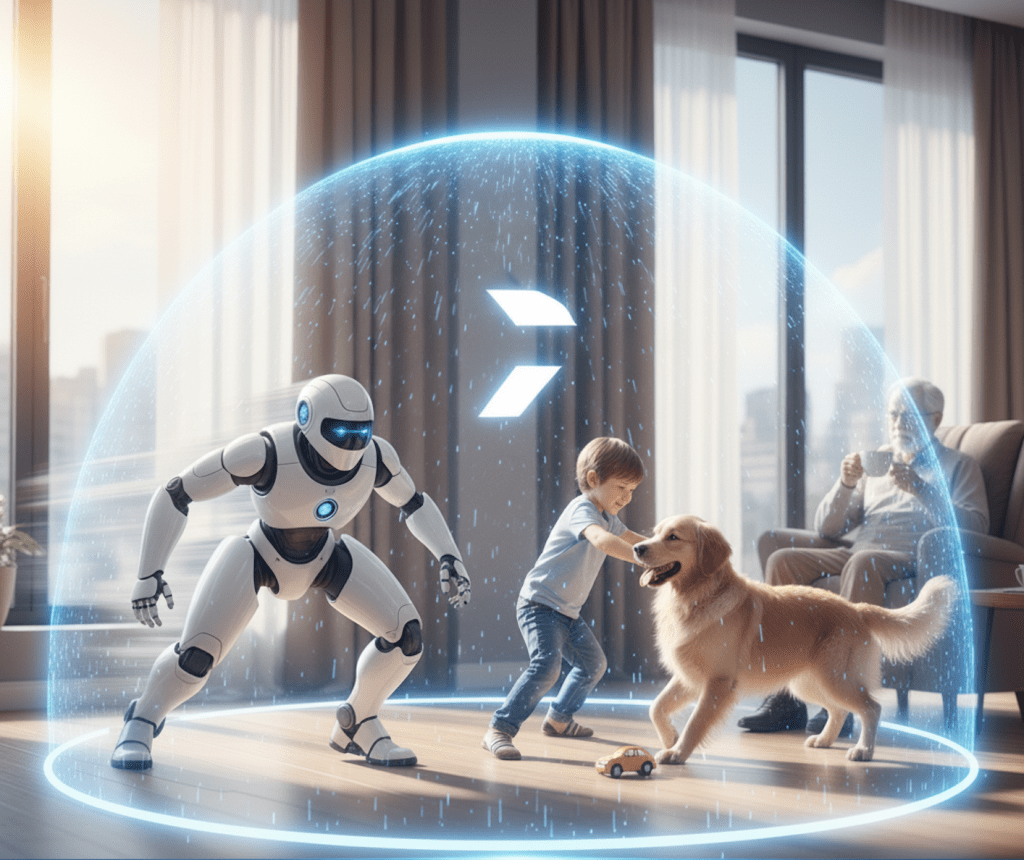
Safety Challenges of Household Robots
With the rapid development of artificial intelligence technology, the ultimate goal of AI-driven robots is to transition from closed industrial environments to diverse, dynamic, and open consumer environments. However, when robots enter the complex and variable household environment, safety becomes the most critical challenge.
The complexity of household environments lies in:
- Diverse users: Elderly, adults, children, and pets coexisting
- Frequent unexpected events: Children suddenly running, objects falling, accidental falls
- Space constraints: Narrow corridors, stairs, furniture-dense areas
- Variable scenarios: Multiple tasks from cleaning and carrying to companionship and entertainment
In such environments, robots must possess reaction speeds that surpass humans to ensure safe coexistence with humans.
Physiological Limits of Human Reaction Speed
To understand the speed advantage of robots, we first need to understand the physiological limitations of human reaction speed:
Hierarchical Structure of Human Reaction Speed
1. Simple Reaction Time
- Basic perception-action reaction cycle
- Average reaction time: 200-250 milliseconds
- Example: Immediately stepping on brakes upon seeing a red light
2. Choice Reaction Time
- Complex reactions requiring judgment and selection
- Average reaction time: 250-400 milliseconds
- Example: Recognizing different traffic signals and taking corresponding actions
3. Sensory Differential Reactions
- Auditory reaction: 140-180 milliseconds (about 30-50 milliseconds faster than visual)
- Visual reaction: 200-250 milliseconds
- Tactile reaction: 150-200 milliseconds
4. Trained Limit Reactions
- Professional athletes or martial artists: 120-150 milliseconds
- International Association of Athletics Federations (IAAF) regulation: Starting reaction times below 100 milliseconds are considered false starts, deemed beyond physiological possibility
5. Physical Limits of Neural Conduction
- Human peripheral nerve conduction speed: 80-120 meters/second
- Complete neural pathway from perception to action requires tens to over a hundred milliseconds
- Conclusion: Human fastest reaction is approximately 100 milliseconds; anything faster requires prediction
Speed Standards for Robot Safety
Insights from Industrial Safety Standards
Existing industrial robot safety standards provide important references:
- ISO 10218 (Industrial Robot Safety Standard): Requires robots to immediately stop or avoid when detecting humans
- ISO/TS 15066 (Collaborative Robot Specifications): Reaction time must be less than 10 milliseconds to ensure low-speed contact safety
- Automotive Airbag Systems: Activation reaction time approximately 2-3 milliseconds
- Automatic Emergency Braking Systems (ADAS): Total delay for perception + judgment + braking typically less than 50 milliseconds
Speed Requirement Analysis for Household Environments
Based on human reaction speed limits (100 milliseconds) and household environment safety requirements, considering cost and benefit, the following standards serve as references:
Minimum Safety Requirement: ≤50 milliseconds
- Ensures no lag behind human reaction speed
- Enables coordinated avoidance with family members
Standard Safety Target: ≤20 milliseconds
- Approaches industrial collaborative robot standards
- Ensures safety in most emergency situations
Ideal Safety State: 5-10 milliseconds
- Approaches automotive airbag level
- Maximizes safety assurance in complex household scenarios
Conclusion: Household robots should be at least one order of magnitude faster than humans, achieving 10-20 millisecond reaction times.
Technical Implementation of Machine Reaction Speed
Complete Reaction Chain Analysis
The reaction speed advantage of modern robots comes from the integration of their electronic-mechanical systems:
| Stage | System Components | Typical Delay | Technical Characteristics |
|---|---|---|---|
| Signal Perception | CMOS sensors, radar, LiDAR | 1-5 milliseconds | High-frequency sampling, parallel processing |
| Signal Transmission | Electronic circuits, optical fibers | <1 millisecond | Near light-speed transmission |
| Central Processing | AI chips (GPU/TPU/dedicated ASIC) | <1 millisecond | Parallel computing, dedicated optimization |
| Command Transmission | Controller to motor drive | 0.1-1 millisecond | Real-time control systems |
| Action Execution | Servo motors, actuators | 1-10 milliseconds | High-speed response motors |
| Total Reaction Time | Complete perception-action cycle | 5-20 milliseconds | System integration optimization |
Key Technical Breakthrough Points
- Fast start-stop capabilities of high-performance servo motors
- Low-inertia design of mechanical structures
- Active safety mechanisms (such as emergency braking)
Safety Logic of Speed Advantage
Preventive Safety vs. Reactive Safety
Traditional safety thinking focuses on “robust protection" — building thicker protective shields and designing stronger restriction mechanisms. However, in dynamic household environments, such passive protection is often limited in effectiveness.
The safety logic of speed advantage lies in transforming “reactive safety" into “preventive safety":
- Time Window Advantage: The gap between 10 milliseconds vs. 100 milliseconds provides robots with 9 times the decision-making time
- Active Avoidance Capability: Robots begin evasive actions before humans are even aware of danger
- Multiple Safety Buffers: Rapid reactions allow implementation of multi-layered safety measures
Practical Application Scenarios
Scenario 1: Child Suddenly Running
- Human reaction: 300 milliseconds (choice reaction) + action delay
- Robot reaction: 10ms perception + 5ms planning + 5ms action = 20 milliseconds
- Safety advantage: Robot can complete avoidance in 15 times less time before child impact
Scenario 2: Elderly Person Accidental Fall
- Human reaction: Requires complete visual processing and judgment, approximately 400-500 milliseconds
- Robot reaction: Posture recognition + trajectory prediction + support preparation < 30 milliseconds
- Safety advantage: Robot can provide support in early stages of falling process
Scenario 3: Pet Crossing Path
- Human reaction: Recognition + judgment + action adjustment ≥ 250 milliseconds
- Robot reaction: Object detection + path replanning < 15 milliseconds
- Safety advantage: Seamless path adjustment, avoiding startling pets
Technical Challenges and Development
Current Limiting Factors
Hardware Limitations:
- High-performance sensor costs
- Mechanical system inertia issues
- Power system response delays
Software Challenges:
- Real-time understanding of complex environments
- Resource allocation for multi-task parallel processing
- Performance optimization of edge AI models
System Integration:
- End-to-end delay in perception-decision-execution
- Temporal synchronization of multi-sensor fusion
- Design of deterministic real-time systems
Conclusion: Speed as the Future Paradigm of Safety
From the martial arts realm of “Only speed is invincible" to the modern robotic achievement of “10-millisecond reaction, preventing myriad dangers," in the era of intelligent homes with human-robot coexistence, they possess:
- Predictive capability: Beginning response before danger occurs
- Precise control: Completing complex actions within millisecond timeframes
- Fault tolerance space: Maintaining sufficient safety buffers even with system delays
Speed is the key for robots to bridge the gap of human-robot coexistence. In household robot safety design, speed is that breakthrough “invincible technique." Future household robots will not only be powerful functional assistants but also safety guardians with “Only speed is invincible" as their core philosophy. With the empowerment of speed, the vision of harmonious human-robot coexistence in smart homes will truly become reality.
速度是機器人的安全保證 : “唯快不破” 功夫
引言:從武學智慧到機器人安全哲學
「天下武功,無堅不摧,唯快不破。」這句廣為流傳的經典台詞出自周星馳2004年電影《功夫》,強調了在武學世界中速度的至關重要性。這個概念最早可追溯至武術家李小龍的實戰哲學,以及古龍在《多情劍客無情劍》中對「小李飛刀」的經典描述——「例無虛發,出手必中」的背後正是極致的速度優勢。
當我們將這一武學智慧延伸至現代科技領域,特別是AI驅動的家用機器人時,會發現一個驚人的相似性:在人機共存的家庭環境中,速度同樣是確保安全的根本保證。
家用機器人的安全挑戰
隨著人工智慧技術的飛躍發展,AI驅動的機器人最終目標是從工業場域封閉環境走向消費多樣動態開放環境。然而,當機器人進入複雜多變的家庭環境時,安全性成為最核心的挑戰。
家庭環境的複雜性在於:
- 多元使用者:老人、成人、兒童、寵物共存
- 突發事件頻繁:兒童突然奔跑、物品掉落、意外跌倒
- 空間限制:狹窄走廊、樓梯、家具密集區域
- 情境多變:從清潔、搬運到陪伴、娛樂等多重任務
在這樣的環境中,機器人必須具備超越人類的反應速度,才能確保與人類的安全共存。
人類反應速度的生理極限
要理解機器人的速度優勢,首先需要了解人類反應速度的生理限制:
人類反應速度的階層結構
1. 簡單反射反應(Simple Reaction Time)
- 基本的感知-動作反應循環
- 平均反應時間:200-250毫秒
- 範例:看到紅燈立即踩煞車
2. 選擇性反應(Choice Reaction Time)
- 需要判斷與選擇的複合反應
- 平均反應時間:250-400毫秒
- 範例:識別不同交通號誌並做出相應動作
3. 感官差異性反應
- 聽覺反應:140-180毫秒(比視覺快約30-50毫秒)
- 視覺反應:200-250毫秒
- 觸覺反應:150-200毫秒
4. 訓練極限反應
- 專業運動員或武術家:120-150毫秒
- 國際田徑總會(IAAF)規定:起跑反應時間低於100毫秒視為搶跑,被認為超出生理可能
5. 神經傳導的物理極限
- 人類周邊神經傳導速度:80-120公尺/秒
- 從感知到動作的完整神經通路需要幾十到一百多毫秒
- 結論:人類最快反應約100毫秒,再快便需依賴預判
機器人安全的速度標準
工業安全標準的啟示
現有的工業機器人安全標準為我們提供了重要參考:
- ISO 10218(工業機器人安全標準):要求機器人檢測到人類時能立即停止或避讓
- ISO/TS 15066(協作機器人規範):反應時間需小於10毫秒才能保證低速接觸安全
- 汽車安全氣囊系統:啟動反應時間約2-3毫秒
- 自動煞車系統(ADAS):感知+判斷+制動的總延遲通常小於50毫秒
家庭環境的速度需求分析
基於人類反應速度極限(100毫秒)和家庭環境的安全需求,考量成本和效益如以下標準參考:
最低安全要求:≤50毫秒
- 確保不落後於人類反應速度
- 能夠與家庭成員協調避讓
標準安全目標:≤20毫秒
- 接近工業協作機器人標準
- 能夠在大多數突發情況下確保安全
理想安全狀態:5-10毫秒
- 接近汽車安全氣囊等級
- 在家庭複雜情境中最大化安全保障
結論:家庭機器人應該至少比人類快一個數量級,達到10-20毫秒的反應時間。
機器反應速度的技術實現
完整反應鏈路分析
現代機器人的反應速度優勢來自於其電子-機械系統的整合:
| 階段 | 系統組件 | 典型延遲 | 技術特點 |
|---|---|---|---|
| 訊號感知 | CMOS感測器、雷達、激光雷達 | 1-5毫秒 | 高頻取樣,並行處理 |
| 訊號傳輸 | 電子電路、光纖 | <1毫秒 | 近光速傳輸 |
| 中央處理 | AI晶片(GPU/TPU/專用ASIC) | <1毫秒 | 並行運算,專用優化 |
| 指令傳遞 | 控制器到馬達驅動 | 0.1-1毫秒 | 實時控制系統 |
| 動作執行 | 伺服馬達、致動器 | 1-10毫秒 | 高速響應馬達 |
| 總反應時間 | 完整感知-行動循環 | 5-20毫秒 | 系統整合優化 |
關鍵技術突破點
- 高性能伺服馬達的快速啟停
- 機械結構的低慣性設計
- 主動安全機制(如緊急制動)
速度優勢的安全邏輯
預防性安全 vs. 反應性安全
傳統安全思維著重於「堅固防護」——建造更厚的防護罩、設計更強的限制機制。但在動態的家庭環境中,這種被動防護往往效果有限。
速度優勢的安全邏輯在於將「反應性安全」轉化為「預防性安全」:
- 時間窗口優勢:10毫秒 vs. 100毫秒的差距,為機器人提供了9倍的決策時間
- 主動避讓能力:在人類尚未意識到危險時,機器人已經開始規避動作
- 多重安全緩衝:快速反應允許實施多層安全措施
實際應用場景
場景一:兒童突然奔跑
- 人類反應:300毫秒(選擇性反應) + 動作延遲
- 機器人反應:10毫秒感知 + 5毫秒規劃 + 5毫秒動作 = 20毫秒
- 安全優勢:機器人可在兒童撞擊前15倍的時間內完成避讓
場景二:老人意外跌倒
- 人類反應:需要完整的視覺處理和判斷,約400-500毫秒
- 機器人反應:姿態識別 + 軌跡預測 + 接護準備 < 30毫秒
- 安全優勢:機器人可在跌倒過程的早期階段提供支撐
場景三:寵物穿越路徑
- 人類反應:識別 + 判斷 + 動作調整 ≥ 250毫秒
- 機器人反應:物體檢測 + 路徑重規劃 < 15毫秒
- 安全優勢:無縫路徑調整,避免驚擾寵物
技術挑戰與發展
當前限制因素
硬體限制:
- 高性能感測器成本
- 機械系統的慣性問題
- 電力系統的響應延遲
軟體挑戰:
- 複雜環境的實時理解
- 多任務並行處理的資源分配
- 邊緣端AI模型的效能最佳化
系統整合:
- 感知-決策-執行的端到端延遲
- 多感測器融合的時序同步
- 確定性實時系統的設計
結論:速度即安全的未來典範
從武術「唯快不破」的武學境界,到現代機器人「10毫秒反應,預防萬險」的技術實現,在人機共存的智慧家庭時代,它們就具備了:
- 預判能力:在危險發生前就開始應對
- 精準控制:在毫秒級時間內完成複雜動作
- 容錯空間:即使系統出現延遲,仍有充足的安全緩衝
速度,是機器人跨越人機共存鴻溝的關鍵。在家庭機器人的安全設計中,速度就是那個突破的「無敵招式」。未來的家庭機器人將不只是功能強大的助手,更將是以「唯快不破」為核心理念的安全守護者。在速度的加持下,人機和諧共存的智慧家庭願景將真正成為現實。
參考資料
- International Federation of Robotics (IFR). (2024). World Robotics 2024 Service Robots Report.
- ISO 10218-1:2011. Robots and robotic devices — Safety requirements for industrial robots — Part 1: Robots. International Organization for Standardization.
- ISO/TS 15066:2016. Robots and robotic devices — Collaborative robots. International Organization for Standardization.
- Fitts, P. M. (1954). The information capacity of the human motor system in controlling the amplitude of movement. Journal of Experimental Psychology, 47(6), 381-391.
- Schmidt, R. A., & Lee, T. D. (2019). Motor Control and Learning: A Behavioral Emphasis (6th ed.). Human Kinetics.
- World Athletics (formerly IAAF). (2019). Competition Rules 2020-2021. Technical Rules.
- 古龍 (1969). 《多情劍客無情劍》. 春秋出版社.
- 《功夫》電影 (2004). 導演:周星馳. 星輝海外有限公司.
- Lee, B. (1975). Tao of Jeet Kune Do. Ohara Publications.
- Siciliano, B., & Khatib, O. (Eds.). (2016). Springer Handbook of Robotics (2nd ed.). Springer.
- National Highway Traffic Safety Administration (NHTSA). (2018). Automatic Emergency Braking Systems Research Report. US Department of Transportation.
- Chen, F., et al. (2023). “Millisecond-scale response in household service robots: A comprehensive survey." IEEE Transactions on Robotics, 39(4), 1245-1262.
Speed Above All: Velocity as the Safety Guarantee for Robots
Introduction: From Martial Arts Wisdom to Robotic Safety Philosophy
“In all martial arts under heaven, nothing is unbreakable, except speed." This widely circulated classic line from Stephen Chow’s 2004 film “Kung Fu Hustle" emphasizes the paramount importance of speed in the world of martial arts. This concept can be traced back to martial artist Bruce Lee’s combat philosophy and Gu Long’s classic description of “Little Li Flying Dagger" in “The Sentimental Swordsman Ruthless Sword" — behind the legendary “never misses, always hits" lies the ultimate advantage of speed.
When we extend this martial arts wisdom to the modern technology field, particularly AI-driven household robots, we discover a striking similarity: in the human-robot coexistence environment of homes, speed is equally the fundamental guarantee of safety.
Safety Challenges of Household Robots
With the rapid development of artificial intelligence technology, the ultimate goal of AI-driven robots is to transition from closed industrial environments to diverse, dynamic, and open consumer environments. However, when robots enter the complex and variable household environment, safety becomes the most critical challenge.
The complexity of household environments lies in:
- Diverse users: Elderly, adults, children, and pets coexisting
- Frequent unexpected events: Children suddenly running, objects falling, accidental falls
- Space constraints: Narrow corridors, stairs, furniture-dense areas
- Variable scenarios: Multiple tasks from cleaning and carrying to companionship and entertainment
In such environments, robots must possess reaction speeds that surpass humans to ensure safe coexistence with humans.
Physiological Limits of Human Reaction Speed
To understand the speed advantage of robots, we first need to understand the physiological limitations of human reaction speed:
Hierarchical Structure of Human Reaction Speed
1. Simple Reaction Time
- Basic perception-action reaction cycle
- Average reaction time: 200-250 milliseconds
- Example: Immediately stepping on brakes upon seeing a red light
2. Choice Reaction Time
- Complex reactions requiring judgment and selection
- Average reaction time: 250-400 milliseconds
- Example: Recognizing different traffic signals and taking corresponding actions
3. Sensory Differential Reactions
- Auditory reaction: 140-180 milliseconds (about 30-50 milliseconds faster than visual)
- Visual reaction: 200-250 milliseconds
- Tactile reaction: 150-200 milliseconds
4. Trained Limit Reactions
- Professional athletes or martial artists: 120-150 milliseconds
- International Association of Athletics Federations (IAAF) regulation: Starting reaction times below 100 milliseconds are considered false starts, deemed beyond physiological possibility
5. Physical Limits of Neural Conduction
- Human peripheral nerve conduction speed: 80-120 meters/second
- Complete neural pathway from perception to action requires tens to over a hundred milliseconds
- Conclusion: Human fastest reaction is approximately 100 milliseconds; anything faster requires prediction
Speed Standards for Robot Safety
Insights from Industrial Safety Standards
Existing industrial robot safety standards provide important references:
- ISO 10218 (Industrial Robot Safety Standard): Requires robots to immediately stop or avoid when detecting humans
- ISO/TS 15066 (Collaborative Robot Specifications): Reaction time must be less than 10 milliseconds to ensure low-speed contact safety
- Automotive Airbag Systems: Activation reaction time approximately 2-3 milliseconds
- Automatic Emergency Braking Systems (ADAS): Total delay for perception + judgment + braking typically less than 50 milliseconds
Speed Requirement Analysis for Household Environments
Based on human reaction speed limits (100 milliseconds) and household environment safety requirements, considering cost and benefit, the following standards serve as references:
Minimum Safety Requirement: ≤50 milliseconds
- Ensures no lag behind human reaction speed
- Enables coordinated avoidance with family members
Standard Safety Target: ≤20 milliseconds
- Approaches industrial collaborative robot standards
- Ensures safety in most emergency situations
Ideal Safety State: 5-10 milliseconds
- Approaches automotive airbag level
- Maximizes safety assurance in complex household scenarios
Conclusion: Household robots should be at least one order of magnitude faster than humans, achieving 10-20 millisecond reaction times.
Technical Implementation of Machine Reaction Speed
Complete Reaction Chain Analysis
The reaction speed advantage of modern robots comes from the integration of their electronic-mechanical systems:
| Stage | System Components | Typical Delay | Technical Characteristics |
|---|---|---|---|
| Signal Perception | CMOS sensors, radar, LiDAR | 1-5 milliseconds | High-frequency sampling, parallel processing |
| Signal Transmission | Electronic circuits, optical fibers | <1 millisecond | Near light-speed transmission |
| Central Processing | AI chips (GPU/TPU/dedicated ASIC) | <1 millisecond | Parallel computing, dedicated optimization |
| Command Transmission | Controller to motor drive | 0.1-1 millisecond | Real-time control systems |
| Action Execution | Servo motors, actuators | 1-10 milliseconds | High-speed response motors |
| Total Reaction Time | Complete perception-action cycle | 5-20 milliseconds | System integration optimization |
Key Technical Breakthrough Points
- Fast start-stop capabilities of high-performance servo motors
- Low-inertia design of mechanical structures
- Active safety mechanisms (such as emergency braking)
Safety Logic of Speed Advantage
Preventive Safety vs. Reactive Safety
Traditional safety thinking focuses on “robust protection" — building thicker protective shields and designing stronger restriction mechanisms. However, in dynamic household environments, such passive protection is often limited in effectiveness.
The safety logic of speed advantage lies in transforming “reactive safety" into “preventive safety":
- Time Window Advantage: The gap between 10 milliseconds vs. 100 milliseconds provides robots with 9 times the decision-making time
- Active Avoidance Capability: Robots begin evasive actions before humans are even aware of danger
- Multiple Safety Buffers: Rapid reactions allow implementation of multi-layered safety measures
Practical Application Scenarios
Scenario 1: Child Suddenly Running
- Human reaction: 300 milliseconds (choice reaction) + action delay
- Robot reaction: 10ms perception + 5ms planning + 5ms action = 20 milliseconds
- Safety advantage: Robot can complete avoidance in 15 times less time before child impact
Scenario 2: Elderly Person Accidental Fall
- Human reaction: Requires complete visual processing and judgment, approximately 400-500 milliseconds
- Robot reaction: Posture recognition + trajectory prediction + support preparation < 30 milliseconds
- Safety advantage: Robot can provide support in early stages of falling process
Scenario 3: Pet Crossing Path
- Human reaction: Recognition + judgment + action adjustment ≥ 250 milliseconds
- Robot reaction: Object detection + path replanning < 15 milliseconds
- Safety advantage: Seamless path adjustment, avoiding startling pets
Technical Challenges and Development
Current Limiting Factors
Hardware Limitations:
- High-performance sensor costs
- Mechanical system inertia issues
- Power system response delays
Software Challenges:
- Real-time understanding of complex environments
- Resource allocation for multi-task parallel processing
- Performance optimization of edge AI models
System Integration:
- End-to-end delay in perception-decision-execution
- Temporal synchronization of multi-sensor fusion
- Design of deterministic real-time systems
Conclusion: Speed as the Future Paradigm of Safety
From the martial arts realm of “speed above all" to the modern robotic achievement of “10-millisecond reaction, preventing myriad dangers," in the era of intelligent homes with human-robot coexistence, they possess:
- Predictive capability: Beginning response before danger occurs
- Precise control: Completing complex actions within millisecond timeframes
- Fault tolerance space: Maintaining sufficient safety buffers even with system delays
Speed is the key for robots to bridge the gap of human-robot coexistence. In household robot safety design, speed is that breakthrough “invincible technique." Future household robots will not only be powerful functional assistants but also safety guardians with “speed above all" as their core philosophy. With the empowerment of speed, the vision of harmonious human-robot coexistence in smart homes will truly become reality.




 PaliPali
發表留言