

How to Reduce AI Replacement Anxiety? Surviving AI’s Rise: Small-World Thinking Builds Your Career Shield
如何減輕被AI取代的焦慮感?在AI浪潮中生存:靠Small World思維打造你的職涯護盾

Abstract
With the rapid development of artificial intelligence technology, workplace environments are undergoing unprecedented reconstruction. This study proposes the concept of “AI Shield" and combines it with Small World network theory to construct a new framework for understanding and addressing workplace anxiety in the AI era. Through analyzing eight types of organizational units, this research explores how individuals and organizations can adapt to the AI wave by establishing network connectivity and protective mechanisms, providing theoretical guidance and practical strategies for alleviating “replacement anxiety."
Keywords: Artificial Intelligence, Small World Networks, Workplace Anxiety, Social Capital, AI Shield
1. Introduction
1.1 Research Background
The exponential development of artificial intelligence technology is reshaping the global employment market. According to the World Economic Forum 2023 report, it is predicted that by 2027, AI will affect 69% of job positions, with 25% of jobs potentially being completely automated (World Economic Forum, 2023). This technological transformation not only brings improvements in production efficiency but also triggers widespread occupational anxiety and “technological displacement anxiety."
1.2 Research Questions and Motivation
Existing research primarily analyzes AI’s impact on employment from technological substitutability and labor economics perspectives (Acemoglu & Restrepo, 2020; Brynjolfsson & McAfee, 2014), with less exploration from psychological and network sociology perspectives regarding individual and organizational adaptation mechanisms. This study attempts to answer:
- In the AI era, how can individuals reduce occupational anxiety through network reconstruction?
- How does the “AI Shield" concept help understand different types of workers’ protective strategies?
- What role does Small World network structure play in workplace adaptation?
1.3 Theoretical Contributions
The innovation of this study lies in:
- First application of Small World network theory to AI-era workplace analysis
- Proposing the “AI Shield" conceptual framework, distinguishing protective strength and types
- Constructing a classification system of eight organizational units, providing practical guidance
2. Small World Theory and Its Application to Language/Information Network Structures
2.1 Theoretical Foundation of Small World Networks
The Small World phenomenon was initially discovered by Milgram’s (1967) “six degrees of separation experiment" and later mathematically modeled by Watts & Strogatz (1998). Small World networks have two key characteristics:
- Short average path length: The shortest distance between any two nodes is relatively small
- High clustering coefficient: Neighbors of nodes have a high probability of connection
Mathematical expression: When clustering coefficient C >> C_random and average path length L ≈ L_random, the network exhibits Small World properties.
2.2 Small World Structure in Language Networks
Ferrer i Cancho & Solé (2001) discovered in the British National Corpus that word co-occurrence networks exhibit typical Small World characteristics:
- High-frequency words serve as “hub" nodes connecting numerous low-frequency words
- Semantically related words form highly clustered local groups
- The overall network maintains relatively short semantic path distances
This finding provides a network science foundation for understanding the efficiency and creativity of human language.
2.3 Connection to Natural Language Processing
The attention mechanisms of modern Large Language Models (LLMs) exhibit structural features similar to Small World networks:
Small World Properties in Transformer Architecture:
- Local attention clustering: Adjacent tokens form highly clustered connections
- Long-distance dependencies: Multi-layer attention enables short-path information transmission
- Sparse attention design: BigBird (Zaheer et al., 2020) and Longformer (Beltagy et al., 2020) construct efficient small-world networks by combining local, global, and random attention patterns
This structure enables LLMs to capture long-distance semantic associations while maintaining local contextual coherence.
3. AI Shield as a Defensive and Proxy Tool: Conceptual Construction
3.1 Conceptual Connotation of AI Shield
“AI Shield" is the core concept proposed in this study, referring to protective mechanisms constructed by individuals or organizations using AI technology for:
- Information filtering: Screening and processing massive information flows
- Capability enhancement: Compensating for individual skill gaps
- Anxiety relief: Providing psychological security and sense of control
- Boundary maintenance: Preserving human agency in human-machine collaboration
3.2 Shield Strength Classification
Based on resource acquisition capability and technological control, AI shields are categorized into:
Strong Shield
- Characteristics: Possessing core AI technology, data resources, and ecosystem control
- Advantages: Structural dominance and rule-making authority
Weak Shield
- Characteristics: Relying on third-party AI tools and APIs
- Advantages: High flexibility and relatively low cost
3.3 Factors Affecting Shield Effectiveness
Referencing the Technology Acceptance Model (Davis, 1989) and Resource-Based View (Barney, 1991), key factors affecting AI shield effectiveness include:
Technical Factors:
- Availability and usability of AI tools
- Data quality and model performance
- System integration and stability
Organizational Factors:
- Resource investment capability
- Organizational learning culture
- Change management capability
Individual Factors:
- Technical literacy and acceptance
- Psychological resilience
- Network social capital
4. Social Capital and Workplace Security: From Connectivity to Survival Capability
4.1 Theoretical Foundation of Social Capital
Strong ties: Provide emotional support, trust foundation, and deep cooperation
Weak ties: Transmit external new information, create opportunities, and promote innovative cooperation
Functional connectivity: Acquiring resources, information, and support through network relationships.
4.2 Reconstruction Mechanisms of Small World Workplace Networks
In the AI era, effective workplace networks exhibit Small World characteristics:
Core Clusters:
- Trust circles formed by strong ties
- Providing psychological support and resource sharing
- Forming “learning communities" to respond to technological changes
Bridge Nodes:
- Key individuals connecting different professional domains
- Facilitating cross-boundary knowledge flow
- Providing career transition opportunities
Weak Tie Networks:
- Extensive professional connections
- Sources of information and opportunities
- Transmitting external new information, creating opportunities, promoting innovative cooperation
4.3 Network Sources of Psychological Safety
Based on Kahn’s (1990) psychological safety theory combined with a network perspective, workplace psychological safety stems from:
- Network embeddedness: Stable position in professional networks
- Connection diversity: Cross-domain and cross-level connections
- Resource accessibility: Rapid access to needed resources through networks
- Identity recognition: Sense of belonging and value recognition in professional groups
5. Eight Major Organizational Units and Future Work Models in the AI Era
5.1 Detailed Analysis of Eight Organizational Units
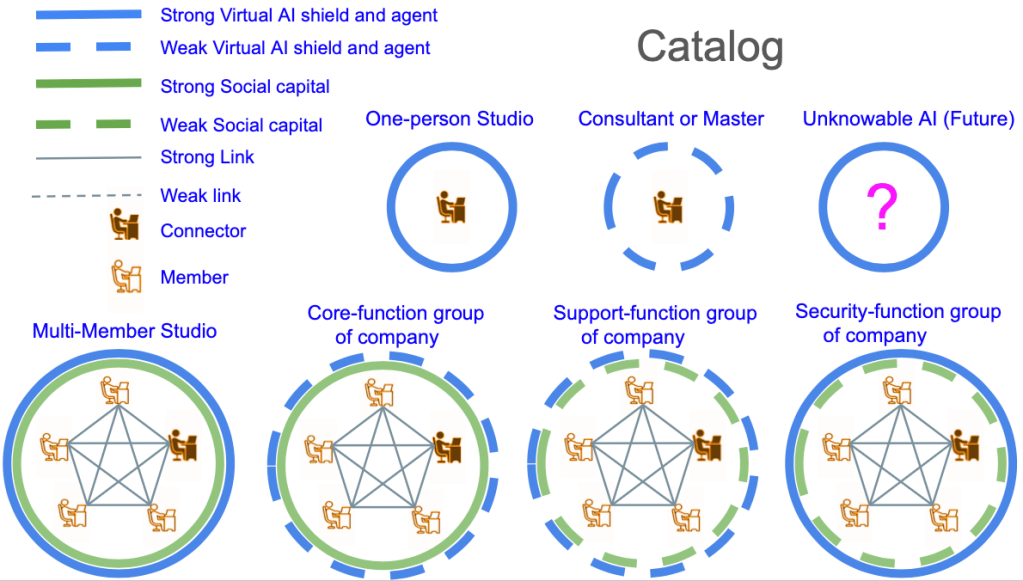
5.1.1 One-person Studio
- Characteristics: Individual entrepreneurs relying on creativity and professional skills
- AI Shield: Strong, capable of professional independent use of AI tools
- Risk: Susceptible to acquisition and merger by Big Tech companies
- Strategy: Development towards high creativity and high emotional value
5.1.2 Consultant/Master
- Characteristics: Independent consultants with deep professional knowledge
- AI Shield: AI as analytical tools
- Advantages: Irreplaceable experiential judgment and decision-making capabilities
- Strategy: Becoming “AI-enhanced wisdom mentors"
5.1.3 Unknowable AI
- Characteristics: Black-box or autonomously evolving AI systems
- Threat Level: Highly unpredictable
- Impact: Potentially disruptive to existing work models
- Response: Establishing regulatory and ethical frameworks
5.1.4 Multi-member Studio
- Characteristics: Small entrepreneurial teams with flexible collaboration
- AI Shield: Strong, relying on internal consensus, sharing AI tools and costs
- Social Capital: Strong internal connections, abundant internal and external organizational resources
- Advantages: Rapid market response capability
- Strategy: Specialized division of labor + AI synergy
5.1.5 Core-function Group
- Characteristics: Core business departments of organizations
- AI Shield: Weak, supported by enterprise-level AI systems
- Social Capital: Strong internal connections, abundant internal and external organizational resources
- Security: Not easily replaceable
- Strategy: Deep human-machine integration, enhancing decision quality
5.1.6 Support-function Group
- Characteristics: Departments providing auxiliary services
- AI Shield: Weak, standardized tools
- Social Capital: Weak, marginalized position
- Risk: Most susceptible to AI replacement
- Strategy: Transition to core functions or specialization
5.1.7 Security-function Group
- Characteristics: Responsible for AI governance and risk control
- AI Shield: Strong, professional protective tools
- Social Capital: Moderate but critically important
- Importance: Increases with AI development
- Strategy: Building AI ethics and security professional capabilities
5.1.8 Big Tech AI Agent
- Characteristics: AI platforms and ecosystems of tech giants
- AI Shield: Super strong, ecosystem-level protection
- Influence: Structural dominance
- Role: Rule makers and platform providers
- Trend: Formation of oligopolistic patterns
5.2 Dynamic Evolution Patterns
Dynamic evolutionary relationships exist among these eight units:
- Upward mobility: Development from weak shields to strong shields through capability enhancement and network building
- Horizontal transfer: Movement between different functional groups to find optimal positions
- Alliance strategies: Weak shield units enhancing collective shield strength through alliances
6. Empirical Case Analysis
6.1 AI Shield Practices in the Design Industry
Using the graphic design industry as an example, analyzing response strategies of different types of designers:
Independent Designers (One-person Studio):
- Utilizing AI tools like Midjourney and DALL-E to enhance creative efficiency
- Focusing on brand strategy and client communication capabilities
- Building personal brand networks through social media
Design Companies (Multi-member Studio):
- Establishing AI tool libraries for team collaboration
- Specialized division of labor: creative conception vs. execution implementation
- Developing partnerships with AI technology companies
6.2 Industry Network Reconstruction
Small World network characteristics:
- Internal company: Strong ties provide trust and cooperation foundation
- Industry expert networks: Weak ties bring diverse insights
- AI tool empowerment: Significantly enhanced data analysis capabilities
7. Policy Recommendations and Practical Strategies
7.1 Individual-Level Strategies
Building Personal AI Shields:
- Skill portfolio optimization: Core capabilities difficult for AI to replace + AI collaboration skills
- Network diversification: Balancing strong and weak ties, establishing cross-boundary connections
- Continuous learning: Maintaining sensitivity and adaptability to new technologies
- Psychological resilience building: Alleviating technological anxiety through network support
Small World Network Building:
- Core circle construction: 3-5 person deep trust networks
- Professional network expansion: Industry associations, professional communities
- Cross-boundary connections: Maintaining weak ties in different fields
- Mentor-mentee relationships: Vertical knowledge transmission
7.2 Organizational-Level Strategies
Enterprise AI Shield Construction:
- Layered shield systems: Enterprise-level + department-level + individual-level AI tools
- Talent development pathways: Transition channels from support functions to core functions
- Network organizational structures: Flat, cross-functional team collaboration
- Change management mechanisms: Helping employees adapt to AI-era changes
7.3 Societal-Level Policies
Educational System Reform:
- Lifelong learning systems: Adapting to rapid technological changes
- Network literacy education: Social capital building capabilities
- AI collaboration skills: Human-machine collaborative work capabilities
- Mental health support: Psychological services for addressing technological anxiety
Labor Policy Adjustments:
- Employment security mechanisms: Support for workers replaced by AI
- Skill transition programs: Transfer from declining to emerging industries
- AI governance frameworks: Ensuring fairness and controllability of AI development
8. Conclusion
This study proposes the theoretical framework of “AI Shield + Small World Networks," providing a new perspective for understanding and addressing workplace transformation in the AI era. Main conclusions include:
8.1 Theoretical Contributions
- Conceptual innovation: First proposal of the “AI Shield" concept, combining technological tools with protective strategies
- Framework integration: Application of Small World network theory to workplace research, providing network-perspective analytical tools
- Classification system: Construction of an eight-type organizational unit classification framework, providing practical guidance
8.2 Practical Implications
- Individual strategies: Through AI shield construction and network optimization, individuals can effectively reduce technological anxiety and enhance adaptability
- Organizational transformation: Enterprises need to establish layered shield systems, helping employees find appropriate positions and roles in the AI era
- Social policies: Need to construct supportive education, employment, and governance policies ensuring inclusive AI development
8.3 Future Prospects
AI technological development is an irreversible trend; the key lies in constructing effective adaptation mechanisms. The “shield network" concept proposed in this study emphasizes:
- Integration of technology and humanities: AI shields are not merely technological tools but psychological and social support systems
- Coordination of individual and collective: Achieving unity of individual adaptation and collective prosperity through network effects
- Balance between present and future: Embracing new technologies while maintaining human values and dignity
The future work world will be a new ecosystem of human-machine collaboration and networked cooperation. Those individuals and organizations capable of effectively building AI shields, optimizing network positions, and maintaining learning capabilities will gain greater development space and psychological security in this new era.
References
Network Theory Foundation:
- Watts, D. J., & Strogatz, S. H. (1998). Collective dynamics of ‘small-world’ networks. Nature, 393(6684), 440-442.
- Milgram, S. (1967). The small world problem. Psychology Today, 2(1), 60-67.
- Granovetter, M. S. (1973). The strength of weak ties. American Journal of Sociology, 78(6), 1360-1380.
Language Network Research:
- Ferrer i Cancho, R., & Solé, R. V. (2001). The small world of human language. Proceedings of the Royal Society of London, 268(1482), 2261-2265.
- Zaheer, M., et al. (2020). Big Bird: Transformers for longer sequences. Advances in Neural Information Processing Systems, 33.
AI and Employment Research:
- Acemoglu, D., & Restrepo, P. (2020). Robots and jobs: Evidence from US labor markets. Journal of Political Economy, 128(6), 2188-2244.
- Brynjolfsson, E., & McAfee, A. (2014). The Second Machine Age. W. W. Norton & Company.
- World Economic Forum. (2023). Future of Jobs Report 2023.
Social Capital Theory:
- Coleman, J. S. (1988). Social capital in the creation of human capital. American Journal of Sociology, 94, S95-S120.
- Kahn, W. A. (1990). Psychological conditions of personal engagement and disengagement at work. Academy of Management Journal, 33(4), 692-724.
Technology Acceptance and Organizational Theory:
- Davis, F. D. (1989). Perceived usefulness, perceived ease of use, and user acceptance of information technology. MIS Quarterly, 13(3), 319-340.
- Barney, J. (1991). Firm resources and sustained competitive advantage. Journal of Management, 17(1), 99-120.
AI時代的職場架構:從Small World網絡到AI護盾與代理
摘要
隨著人工智慧技術的快速發展,職場環境正經歷前所未有的重構。本研究提出「AI護盾」概念,結合Small World網絡理論,構建了理解和應對AI時代職場焦慮的新框架。通過分析八種組織單元類型,探討個體與組織如何通過建立網絡連結性和防護機制來適應AI浪潮,為減緩「被取代焦慮」提供理論指導和實踐策略。
關鍵詞: 人工智慧、Small World網絡、職場焦慮、社會資本、AI護盾
一、前言
1.1 研究背景
人工智慧技術的指數級發展正在重塑全球就業市場。根據世界經濟論壇2023年報告,預計到2027年,AI將影響69%的工作崗位,其中25%的工作可能被完全自動化(World Economic Forum, 2023)。這種技術變革不僅帶來了生產效率的提升,也引發了廣泛的職業焦慮和「被取代恐懼」(technological displacement anxiety)。
1.2 研究問題與動機
現有研究多從技術替代性和勞動經濟學角度分析AI對就業的影響(Acemoglu & Restrepo, 2020; Brynjolfsson & McAfee, 2014),較少從心理學和網絡社會學視角探討個體與組織的適應機制。本研究嘗試回答:
- 在AI時代,個體如何通過網絡重構減緩職業焦慮?
- 「AI護盾」概念如何幫助理解不同類型工作者的防護策略?
- Small World網絡結構在職場適應中發揮何種作用?
1.3 理論貢獻
本研究的創新在於:
- 首次將Small World網絡理論應用於AI時代職場分析
- 提出「AI護盾」概念框架,區分防護強度與類型
- 構建八種組織單元的分類體系,提供實踐指導
二、Small World理論與語言/資訊網絡的結構應用
2.1 Small World網絡的理論基礎
Small World現象最初由Milgram(1967)的「六度分隔實驗」發現,後由Watts & Strogatz(1998)建立數學模型。Small World網絡具有兩個關鍵特徵:
- 短平均路徑長度:任意兩節點間的最短距離較小
- 高聚集係數:節點的鄰居之間有較高的連接機率
數學表達為:當聚集係數 C >> C_random 且平均路徑長度 L ≈ L_random 時,網絡呈現Small World特性。
2.2 語言網絡中的Small World結構
Ferrer i Cancho & Solé(2001)在British National Corpus中發現,詞彙共現網絡展現典型的Small World特徵:
- 高頻詞作為「hub」節點連接眾多低頻詞
- 語義相關詞彙形成高聚集的局部群集
- 整體網絡保持較短的語義路徑距離
這一發現為理解人類語言的高效性和創造性提供了網絡科學基礎。
2.3 與自然語言處理的連結
現代大型語言模型(LLMs)的注意力機制呈現類似Small World的結構特徵:
Transformer架構中的小世界性質:
- 局部注意力聚集:相鄰token之間形成高聚集連接
- 長距離依賴:通過多層注意力實現短路徑資訊傳遞
- 稀疏注意力設計:BigBird(Zaheer et al., 2020)和Longformer(Beltagy et al., 2020)通過結合局部、全局和隨機注意力模式,構建高效的小世界網絡
這種結構使LLMs能夠在保持局部語境連貫性的同時,捕捉長距離語義關聯。
三、AI護盾作為防衛性與代理性工具的概念建構
3.1 AI護盾的概念內涵
「AI護盾」(AI Shield)是本研究提出的核心概念,指個體或組織利用AI技術構建的防護機制,用於:
- 資訊過濾:篩選和處理海量資訊流
- 能力增強:補足個體技能短板
- 焦慮緩解:提供心理安全感和控制感
- 邊界維護:在人機協作中保持人類主體性
3.2 護盾強度分類
基於資源獲取能力和技術掌控度,將AI護盾分為:
強護盾(Strong Shield)
- 特徵:擁有核心AI技術、數據資源、生態控制力
- 優勢:結構性主導地位,規則制定權
弱護盾(Weak Shield)
- 特徵:依賴第三方AI工具和API
- 優勢:靈活性高,成本相對較低
3.3 護盾效能的影響因素
參考Technology Acceptance Model(Davis, 1989)和Resource-Based View(Barney, 1991),影響AI護盾效能的關鍵因素包括:
技術因素:
- AI工具的可用性和易用性
- 數據品質和模型性能
- 系統整合度和穩定性
組織因素:
- 資源投入能力
- 組織學習文化
- 變革管理能力
個體因素:
- 技術素養和接受度
- 心理韌性(Psychological Resilience)
- 網絡社會資本
四、社會資本與職場安全感:從連結性到生存能力
4.1 社會資本理論基礎
強連結:提供情感支持、信任基礎、深度合作
弱連結:傳遞外部新資訊、創造機會、促進創新合作
連結的功能性:通過網絡關係獲取資源、資訊和支持。
4.2 Small World職場網絡的重構機制
在AI時代,有效的職場網絡呈現Small World特徵:
核心聚集群(Core Clusters):
- 由強連結構成的信任圈
- 提供心理支持和資源共享
- 形成「學習共同體」應對技術變化
橋接節點(Bridge Nodes):
- 連接不同專業領域的關鍵人物
- 促進跨界知識流動
- 提供職業轉換機會
弱連結網絡(Weak Tie Networks):
- 廣泛的專業聯繫
- 資訊和機會的來源
- 傳遞外部新資訊、創造機會、促進創新合作
4.3 心理安全感的網絡來源
基於Kahn(1990)的心理安全感理論,結合網絡視角,職場心理安全感來源於:
- 網絡嵌入性:在專業網絡中的穩固地位
- 連結多樣性:擁有跨領域、跨層級的聯繫
- 資源可達性:通過網絡快速獲取所需資源
- 身份認同:在專業群體中的歸屬感和價值認同
五、AI時代的八大組織單元與未來工作模型
5.1 八種組織單元詳細分析
5.1.1 One-person Studio(獨立工作室)
- 特徵:個體創業者,依賴創意和專業技能
- AI護盾:強,能專業獨立使用AI工具
- 風險:容易被 Big Tech company 收購合併
- 策略:向高創意、高情感價值方向發展
5.1.2 Consultant/Master(諮詢專家)
- 特徵:擁有深度專業知識的獨立顧問
- AI護盾:AI作為分析工具
- 優勢:不可替代的經驗判斷和決策能力
- 策略:成為「AI增強的智慧導師」
5.1.3 Unknowable AI(不可預測AI)
- 特徵:黑箱或自主演化的AI系統
- 威脅性:高度不可預測
- 影響:可能顛覆現有工作模式
- 應對:建立監管和倫理框架
5.1.4 Multi-member Studio(多人工作室)
- 特徵:小型創業團隊,靈活協作
- AI護盾:強,依賴內部共識,共享AI工具和成本
- 社會資本:強內部連結,組織內外資源豐富
- 優勢:快速響應市場變化
- 策略:專業化分工 + AI協同
5.1.5 Core-function Group(核心職能群)
- 特徵:組織的核心業務部門
- AI護盾:弱,企業級AI系統支持
- 社會資本:強內部連結,組織內外資源豐富
- 安全性:不易被替代
- 策略:人機深度融合,提升決策品質
5.1.6 Support-function Group(支援職能群)
- 特徵:提供輔助性服務的部門
- AI護盾:弱,標準化工具
- 社會資本:弱,邊緣化位置
- 風險:最易被AI替代
- 策略:向核心職能轉型或專業化
5.1.7 Security-function Group(安全職能群)
- 特徵:負責AI治理和風險管控
- AI護盾:強,專業防護工具
- 社會資本:中等但關鍵性強
- 重要性:隨AI發展而增加
- 策略:建立AI倫理和安全專業能力
5.1.8 Big Tech AI Agent(大型科技AI代理)
- 特徵:科技巨頭的AI平台和生態
- AI護盾:超強,生態級防護
- 影響力:結構性主導地位
- 角色:規則制定者和平台提供者
- 趨勢:寡頭壟斷格局形成
5.2 動態演化模式
這八種單元之間存在動態演化關係:
- 向上流動:通過能力提升和網絡建設,從弱護盾向強護盾發展
- 橫向轉移:在不同職能群間流動,尋找最適位置
- 聯盟策略:弱護盾單元通過聯盟增強集體護盾強度
六、實證案例分析
6.1 設計行業的AI護盾實踐
以圖形設計行業為例,分析不同類型設計師的應對策略:
獨立設計師(One-person Studio):
- 利用Midjourney、DALL-E等AI工具提升創作效率
- 重點發展品牌策略和客戶溝通能力
- 通過社群媒體建立個人品牌網絡
設計公司(Multi-member Studio):
- 建立AI工具庫,實現團隊協作
- 分工專業化:創意構思 vs 執行實現
- 發展與AI技術公司的合作關係
6.2 行業的網絡重構
Small World網絡特徵:
- 公司內部:強連結提供信任和合作基礎
- 行業專家網絡:弱連結帶來多樣化見解
- AI工具賦能:數據分析能力顯著提升
七、政策建議與實踐策略
7.1 個體層面策略
構建個人AI護盾:
- 技能組合優化:AI難以替代的核心能力 + AI協作技能
- 網絡多元化:平衡強弱連結,建立跨界聯繫
- 持續學習:保持對新技術的敏感度和適應性
- 心理韌性建設:通過網絡支持緩解技術焦慮
Small World網絡建設:
- 核心圈構建:3-5人的深度信任網絡
- 專業網絡擴展:行業協會、專業社群
- 跨界連結:不同領域的弱連結維護
- 導師與門徒關係:垂直方向的知識傳遞
7.2 組織層面策略
企業AI護盾建設:
- 分層護盾體系:企業級 + 部門級 + 個人級AI工具
- 人才發展路徑:從支援職能向核心職能的轉型通道
- 網絡型組織結構:扁平化、跨功能團隊協作
- 變革管理機制:幫助員工適應AI時代變化
7.3 社會層面政策
教育體系改革:
- 終身學習體系:適應快速技術變化
- 網絡素養教育:社會資本建設能力
- AI協作技能:人機協同工作能力
- 心理健康支持:應對技術焦慮的心理服務
勞動政策調整:
- 就業保障機制:為被AI替代的工作者提供支持
- 技能轉換計畫:從衰退行業向新興行業的轉移
- AI治理框架:確保AI發展的公平性和可控性
八、結論
本研究提出了「AI護盾 + Small World網絡」的理論框架,為理解和應對AI時代的職場變革提供了新視角。主要結論包括:
8.1 理論貢獻
- 概念創新:首次提出「AI護盾」概念,將技術工具與防護策略結合
- 框架整合:將Small World網絡理論應用於職場研究,提供了網絡視角的分析工具
- 分類體系:構建了八種組織單元的分類框架,為實踐提供指導
8.2 實踐啟示
- 個體策略:通過AI護盾建設和網絡優化,個體可以有效減緩技術焦慮,提升適應能力
- 組織變革:企業需要建立分層護盾體系,幫助員工在AI時代找到合適的位置和角色
- 社會政策:需要構建支持性的教育、就業和治理政策,確保AI發展的包容性
8.3 未來展望
AI技術的發展是不可逆轉的趨勢,關鍵在於如何構建有效的適應機制。本研究提出的「護盾網絡」概念強調:
- 技術與人文的結合:AI護盾不僅是技術工具,更是心理和社會支持系統
- 個體與集體的協調:通過網絡效應,實現個體適應與集體繁榮的統一
- 當下與未來的平衡:在擁抱新技術的同時,保持人類價值和尊嚴
未來的工作世界將是一個人機協同、網絡化協作的新生態。那些能夠有效建設AI護盾、優化網絡位置、保持學習能力的個體和組織,將在這個新時代中獲得更大的發展空間和心理安全感。
參考文獻
網絡理論基礎:
- Watts, D. J., & Strogatz, S. H. (1998). Collective dynamics of ‘small-world’ networks. Nature, 393(6684), 440-442.
- Milgram, S. (1967). The small world problem. Psychology Today, 2(1), 60-67.
- Granovetter, M. S. (1973). The strength of weak ties. American Journal of Sociology, 78(6), 1360-1380.
語言網絡研究:
- Ferrer i Cancho, R., & Solé, R. V. (2001). The small world of human language. Proceedings of the Royal Society of London, 268(1482), 2261-2265.
- Zaheer, M., et al. (2020). Big Bird: Transformers for longer sequences. Advances in Neural Information Processing Systems, 33.
AI與就業研究:
- Acemoglu, D., & Restrepo, P. (2020). Robots and jobs: Evidence from US labor markets. Journal of Political Economy, 128(6), 2188-2244.
- Brynjolfsson, E., & McAfee, A. (2014). The Second Machine Age. W. W. Norton & Company.
- World Economic Forum. (2023). Future of Jobs Report 2023.
社會資本理論:
- Coleman, J. S. (1988). Social capital in the creation of human capital. American Journal of Sociology, 94, S95-S120.
- Kahn, W. A. (1990). Psychological conditions of personal engagement and disengagement at work. Academy of Management Journal, 33(4), 692-724.
技術接受與組織理論:
- Davis, F. D. (1989). Perceived usefulness, perceived ease of use, and user acceptance of information technology. MIS Quarterly, 13(3), 319-340.
- Barney, J. (1991). Firm resources and sustained competitive advantage. Journal of Management, 17(1), 99-120.




 PaliPali
發表留言