

道德經第十一章:有之以為利,無之以為用
三十輻共一轂,當其無,有車之用。埏埴以為器,當其無,有器之用。鑿戶牖以為室,當其無,有室之用。故有之以為利,無之以為用。
Abstract
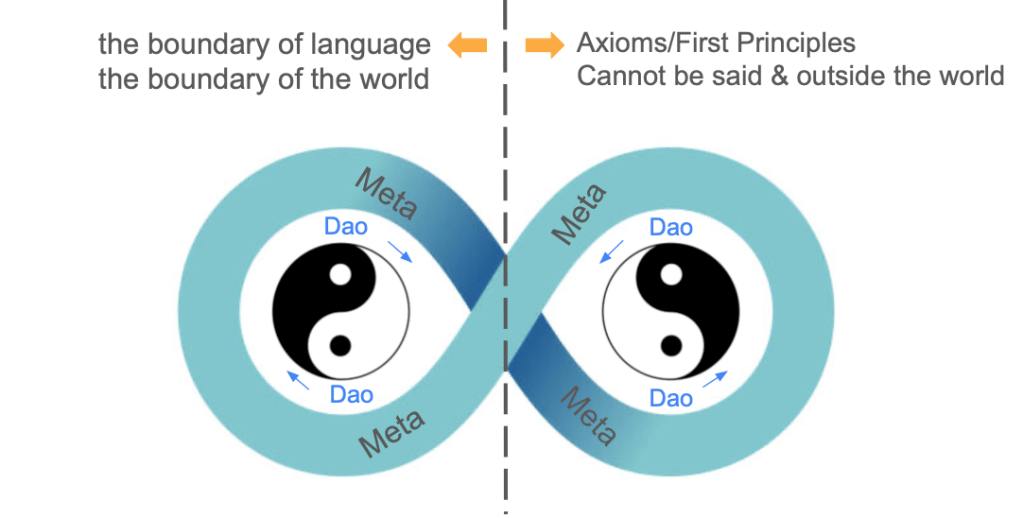
This paper explores the similarities and differences among the concept of “Meta" in Western philosophy, “Dao" (道) in Chinese Daoist philosophy, and “axioms/first principles" in logic and mathematics. Through cross-cultural philosophical comparison, this study reveals the deep structures of these three concepts at epistemological, ontological, and methodological levels, and explores their significance for modern AI system design.
Keywords: Meta-theory, Daoist philosophy, first principles, cross-cultural philosophy, systems theory
1. Introduction
Throughout the development of philosophical history, different cultural traditions have exhibited both similar and divergent understandings of concepts related to “fundamentality," “transcendence," and “foundationality." The concept of “Meta" in Western analytic philosophy, “Dao" in Chinese Daoist thought, and “axioms/first principles" in mathematical logic each attempt to grasp the fundamental structure of reality from different perspectives.
With the advancement of artificial intelligence technology, these traditional philosophical concepts have acquired new application contexts and theoretical significance. Concepts such as meta-learning, metacognition, and axiomatized system design are becoming increasingly important in AI research, while the holistic perspective of Daoist thought provides new frameworks for AI ethics and system architecture.
The research questions of this paper are: How do these three concepts relate to each other at epistemological and ontological levels? How do their differences reflect the distinctive thinking characteristics of different philosophical traditions? What implications does this comparative study have for modern AI system design?
2. Literature Review and Theoretical Foundation
2.1 The Philosophical Development of the Meta Concept
The concept of “Meta" originates from Aristotle’s Metaphysics, originally meaning “after physics." In modern analytic philosophy, the Meta concept has undergone significant development:
Alfred Tarski (1933) systematically distinguished between object language and meta-language in “The Concept of Truth in Formalized Languages," establishing the foundation of modern logical semantics (Tarski, 1933). This distinction resolved semantic paradox problems and became an important milestone in subsequent Meta-theory development.
Bertrand Russell proposed type theory in Principia Mathematica, which is essentially a Meta-level logical structure used to avoid logical paradoxes (Russell & Whitehead, 1910-1913).
Douglas Hofstadter (1979) in Gödel, Escher, Bach deeply explored the philosophical implications of self-reference and recursive structures, connecting Meta concepts with cognitive science and artificial intelligence.
2.2 The Philosophical Content of Dao
Laozi in the opening chapter of the Dao De Jing states: “The Dao that can be spoken is not the eternal Dao; the name that can be named is not the eternal name." This expression reveals the trans-linguistic and trans-conceptual characteristics of Dao.
Feng Youlan (1948) in A Short History of Chinese Philosophy interpreted Dao as “the fundamental principle of the universe," emphasizing that it is both the source of existence and the standard of value.
A.C. Graham (1989) in Disputers of the Tao analyzed the concept of Dao from a linguistic philosophy perspective, arguing that Dao embodies the holistic characteristics of Chinese thinking, contrasting with Western analytical thinking.
Chad Hansen (1992) in A Daoist Theory of Chinese Thought proposed that the concept of Dao reflects Chinese philosophy’s emphasis on “guidance" rather than “truth."
2.3 The Logical Status of Axioms and First Principles
Aristotle in Posterior Analytics proposed that first principles are “unprovable but self-evident truths," serving as the starting point of all reasoning.
Euclid’s Elements established the paradigm of the axiomatic method, demonstrating the possibility of deriving complex theoretical systems from a few axioms.
David Hilbert (1899) in Foundations of Geometry proposed the formalized axiomatic method, emphasizing the consistency, completeness, and independence of axioms.
Kurt Gödel (1931) with his incompleteness theorems revealed fundamental limitations of formal systems, challenging the absoluteness of first principles.
3. Comparative Analysis of Meta and Dao
3.1 Similarities: Transcendence and Fundamentality
3.1.1 Common Characteristics of Transcendent Levels
Transcendence of Meta: The Meta concept provides a cognitive level that is “about about." As Gregory Bateson (1972) argued in Steps to an Ecology of Mind, meta-communication is “communication about communication," transcending the direct content level to enter the level of structure and rules.
Transcendence of Dao: The Dao in Daoist thought transcends all concrete beings. Chapter 25 of the Dao De Jing: “There is something chaotically formed, born before Heaven and Earth. Silent and void, it stands alone and does not change, goes around and does not weary, can be regarded as the mother of Heaven and Earth." This indicates that Dao possesses transcendence in both time and space.
Comparative Analysis: The transcendence of both concepts manifests at different levels: Meta’s transcendence is epistemological, transcending objective knowledge to enter reflective knowledge; Dao’s transcendence is ontological, transcending the phenomenal world to enter the ontological realm.
3.1.2 Abstractness and Universality
Abstractness of Meta: In information science, metadata is not the data itself but data about data. This abstractness gives the Meta concept cross-domain applicability.
Universality of Dao: Chapter 34 of the Dao De Jing: “Great Dao is broad and can go left or right." The universality of Dao is manifested not only in its spatial omnipresence but also in its role as the basis of all existence.
3.2 Differences: The Divide Between Instrumentality and Ontology
3.2.1 Epistemological vs. Ontological Orientation
Instrumental Characteristics of Meta:
- Pragmatic level: Meta-language is used to describe and analyze the structure of object language
- Cognitive science level: Meta-cognition focuses on strategies of learning and thinking
- Systems theory level: Meta-systems provide monitoring and regulation of system operations
Ontological Characteristics of Dao:
- Cosmological level: Dao is the source and driving force of the generation of all things
- Ethical level: Dao provides the highest criterion for behavior
- Cultivation level: Realizing Dao is the highest realm of human life
Theoretical Deepening: This difference reflects the fundamental distinction between Western analytic philosophy and Chinese holistic philosophy. As Tang Yijie (1988) pointed out, Western philosophy focuses on “knowledge of knowledge," while Chinese philosophy emphasizes “wisdom of wisdom."
3.2.2 Differences in Degree of Systematization
Systematization Characteristics of Meta:
- Can establish formalized meta-theories
- Supports recursive structures (meta-meta-language)
- Can be programmed and computed
Non-systematization Characteristics of Dao:
- “The Dao that can be spoken is not the eternal Dao" — essentially unspeakable
- Emphasizes intuitive comprehension and direct apprehension
- Requires understanding through practice and cultivation
Zhuangzi in “The Adjustment of Controversies" further explains the non-fixable nature of Dao through the concept of “dao shu" (道樞): “The pivot of Dao finds its center in the ring, responding to the infinite."
4. Comparative Analysis of Meta and Axioms/First Principles
4.1 Similarities: Systematic Foundational Status
4.1.1 Similarity in Structural Functions
Structural Functions of Meta:
- Organizational: Provides organizational frameworks for knowledge
- Normative: Establishes rules for thinking and operation
- Reflective: Promotes examination of processes themselves
Structural Functions of Axioms:
- Foundational: Serves as the starting point for reasoning
- Generative: Produces theorems through logical deduction
- Consistent: Ensures coordination of the entire theoretical system
4.1.2 Applications in AI Systems
Meta-learning Applications:
- Neural Architecture Search (NAS): Learning how to design network structures
- Few-shot learning: Learning how to learn from few samples
- Adaptive systems: Learning how to adjust learning strategies
Axiomatized AI Systems:
- Knowledge graphs: Ontology-based knowledge representation
- Theorem provers: Automatic reasoning based on logical axioms
- Constraint satisfaction: Rule-based problem solving
4.2 Differences: Descriptive Layer vs. Foundation Layer
4.2.1 Differences in Logical Status
Descriptive Status of Meta:
- Is “system about systems"
- Does not directly participate in object-level operations
- Possesses characteristics of an external observer
Foundational Status of Axioms:
- Is “starting point within the system"
- Directly participates in reasoning processes
- Possesses characteristics of an internal participant
Philosophical Deepening: This distinction involves Martin Heidegger’s differentiation between “Being" and “beings." Meta concepts are closer to inquiry into Being, while axioms are closer to determinations of beings.
4.2.2 Provability and Questionability
Characteristics of Meta Propositions:
- Usually can be examined through higher-level meta propositions
- Possess relativity and corrigibility
- Support the possibility of infinite recursion
Characteristics of Axioms:
- Unprovable within a given system
- Possess absoluteness within the system
- Do not support same-level recursion
Implications of Gödel’s Theorem: Gödel’s incompleteness theorems show that any formal system containing natural number arithmetic is either inconsistent or incomplete. This reveals fundamental limitations of the axiomatic method and provides necessity arguments for meta-level thinking.
5. Integrative Understanding of the Three Concepts
5.1 A Hierarchical Perspective
From a systems hierarchy perspective, we can construct the following understanding framework:
First Level: Axioms/First Principles
- Serves as the foundation of the system
- Provides starting points for reasoning
- Possesses unquestionable status
Second Level: Dao
- Serves as the source of existence
- Transcends all systematic determinations
- Possesses generativity and dynamism
Third Level: Meta
- Serves as a tool for reflection
- Provides description and control of systems
- Possesses recursivity and openness
5.2 Integrative Significance in AI Philosophy
5.2.1 Triple Foundation of AI Systems
Axiomatized Foundation: Ensures logical consistency of AI systems Dao-based Foundation: Embodies holistic harmony of AI systems
Meta-based Foundation: Realizes self-reflection and improvement capabilities of AI systems
5.2.2 Implications for AGI Development
Technical Level: Needs to combine formalized methods (axioms), holistic thinking (Dao), and reflective mechanisms (Meta)
Ethical Level: AI development should follow the harmonious principles of “Dao," utilize the reflective capacity of “Meta," based on the rational foundation of “axioms"
Social Level: The relationship between AI and human society needs to achieve balance across these three dimensions
6. Conclusion and Future Prospects
Through comparative study of the three concepts of Meta, Dao, and axioms/first principles, this paper reveals different ways that different cultural traditions respond to fundamental questions:
- The Meta concept embodies Western analytic philosophy’s emphasis on reflexivity and systematicity
- The concept of Dao embodies Chinese philosophy’s grasp of holism and dynamism
- The axiom concept embodies logic’s pursuit of foundationality and certainty
This integration of triple perspectives provides richer theoretical resources for understanding complex systems (including AI systems). Future research can be developed in the following directions:
- Exploring the application mechanisms of the three concepts in specific AI technologies
- Studying the significance of cross-cultural philosophical dialogue in technology ethics
- Developing new AI system architectures based on this integrative perspective
References
Aristotle. Posterior Analytics.
Bateson, G. (1972). Steps to an Ecology of Mind. University of Chicago Press.
Feng, Y. (1948). A Short History of Chinese Philosophy.
Gödel, K. (1931). Über formal unentscheidbare Sätze der Principia Mathematica und verwandter Systeme. Monatshefte für Mathematik, 38, 173-198.
Graham, A.C. (1989). Disputers of the Tao: Philosophical Argument in Ancient China. Open Court.
Hansen, C. (1992). A Daoist Theory of Chinese Thought. Oxford University Press.
Heidegger, M. (1962). Being and Time. Harper & Row.
Hilbert, D. (1899). Grundlagen der Geometrie. Teubner.
Hofstadter, D. (1979). Gödel, Escher, Bach: An Eternal Golden Braid. Basic Books.
Laozi. Dao De Jing (道德經).
Russell, B. & Whitehead, A.N. (1910-1913). Principia Mathematica. Cambridge University Press.
Tarski, A. (1933). The concept of truth in formalized languages. Logic, Semantics, Metamathematics, 152-278.
Tang, Y. (1988). Comparative Studies of Chinese and Western Philosophy (中西哲學比較研究). Peking University Press.
Zhuangzi. “The Adjustment of Controversies" (齊物論).
元、道與第一原理:跨文化哲學概念的比較研究
摘要
本文探討西方哲學中的「Meta」概念、中國道家哲學中的「道」,以及邏輯學與數學中的「公理/第一原理」之間的異同關係。通過跨文化哲學比較的方法,本研究揭示這三個概念在認識論、本體論和方法論層面的深層結構,並探討其在現代AI系統設計中的應用意義。
關鍵詞: Meta理論、道家哲學、第一原理、跨文化哲學、系統論
1. 引言
在哲學史的發展中,不同文化傳統對「根本性」、「超越性」和「基礎性」概念的理解呈現出既相似又差異的特徵。西方分析哲學中的「Meta」概念、中國道家思想中的「道」,以及數理邏輯中的「公理/第一原理」,分別從不同角度試圖把握現實的根本結構。
隨著人工智慧技術的發展,這些傳統哲學概念獲得了新的應用場景和理論意義。Meta-learning、元認知、公理化系統設計等概念在AI研究中日益重要,而道家思想的整體性視野也為AI倫理和系統架構提供了新的思考框架。
本文的研究問題是:這三個概念如何在認識論和本體論層面相互關聯?它們的差異性如何體現不同哲學傳統的思維特色?這種比較研究對現代AI系統設計有何啟示意義?
2. 文獻回顧與理論基礎
2.1 Meta概念的哲學發展
「Meta」概念起源於亞里士多德的《形而上學》(Metaphysics),原意為「物理學之後」。在現代分析哲學中,Meta概念經歷了重要的發展:
塔爾斯基(Alfred Tarski, 1933) 在《形式化語言中的真理概念》中系統性地區分了對象語言(object language)和元語言(meta-language),建立了現代邏輯語義學的基礎(Tarski, 1933)。這一區分解決了語義悖論問題,成為後續Meta理論發展的重要里程碑。
羅素(Bertrand Russell) 在《數學原理》中提出的類型理論,實質上是一種Meta層級的邏輯結構,用以避免邏輯悖論(Russell & Whitehead, 1910-1913)。
道格拉斯·霍夫施塔特(Douglas Hofstadter, 1979) 在《哥德爾、艾舍爾、巴赫》中深入探討了自指涉(self-reference)和遞迴結構的哲學意涵,將Meta概念與認知科學、人工智慧聯繫起來。
2.2 道的哲學內涵
老子 在《道德經》首章即提出:「道可道,非常道;名可名,非常名。」這一表述揭示了道的超語言性和超概念性特徵。
馮友蘭(1948) 在《中國哲學簡史》中將道詮釋為「宇宙的根本原理」,強調其既是存在的根源,又是價值的標準。
葛瑞漢(A.C. Graham, 1989) 在《道的爭辯者》中從語言哲學角度分析道的概念,認為道體現了中國思維的整體性特徵,與西方的分析性思維形成對比。
陳德興(Chad Hansen, 1992) 在《古代中國的語言與邏輯》中提出,道的概念體現了中國哲學對「指導」(guidance)而非「真理」(truth)的重視。
2.3 公理與第一原理的邏輯地位
亞里士多德 在《後分析篇》中提出,第一原理是「不可證明但自明的真理」,是一切推理的起點(Aristotle, Posterior Analytics)。
歐幾里得 的《幾何原本》建立了公理化方法的典範,展示了從少數公理推導出複雜理論體系的可能性。
希爾伯特(David Hilbert, 1899) 在《幾何學基礎》中提出了形式化的公理方法,強調公理的一致性、完備性和獨立性。
哥德爾(Kurt Gödel, 1931) 的不完備性定理揭示了形式系統的根本限制,對第一原理的絕對性提出了挑戰。
3. Meta與道的比較分析
3.1 相同之處:超越性與根本性
3.1.1 超越層次的共同特徵
Meta的超越性: Meta概念提供了一個「關於關於」的認知層次。正如巴特斯(Gregory Bateson, 1972) 在《心智與自然的統一》中所論述的,Meta-溝通是「關於溝通的溝通」,它超越了直接的內容層面,進入了結構和規則的層面。
道的超越性: 道家思想中的道超越了所有具體的存在物。《道德經》第25章:「有物混成,先天地生。寂兮寥兮,獨立而不改,周行而不殆,可以為天地母。」這表明道在時間和空間上都具有超越性。
比較分析: 兩者的超越性體現在不同層面:Meta的超越是認識論的,它超越了對象性知識進入反思性知識;道的超越是本體論的,它超越了現象界進入本體界。
3.1.2 抽象性與普遍性
Meta的抽象性: 在資訊科學中,metadata(元數據)不是數據本身,而是關於數據的數據。這種抽象性使得Meta概念具有了跨領域的適用性。
道的普遍性: 《道德經》第34章:「大道汎兮,其可左右。」道的普遍性不僅體現在空間的無所不在,更體現在其作為一切存在的根據。
3.2 不同之處:工具性與本體性的分野
3.2.1 認識論取向vs本體論取向
Meta的工具性特徵:
- 語用學層面: Meta-語言用於描述和分析對象語言的結構
- 認知科學層面: Meta-認知關注學習和思考的策略
- 系統論層面: Meta-系統提供對系統運作的監控和調節
道的本體性特徵:
- 宇宙論層面: 道是萬物生成的根源和動力
- 倫理學層面: 道提供行為的最高準則
- 修養論層面: 體道是人生的最高境界
理論深化: 這一差異反映了西方分析哲學與中國整體哲學的根本不同。如湯一介(1988) 所指出的,西方哲學注重「知識的知識」,中國哲學注重「智慧的智慧」。
3.2.2 可系統化程度的差異
Meta的系統化特徵:
- 可以建立形式化的Meta-理論
- 支持遞迴結構(meta-meta-language)
- 可以程式化和計算化
道的非系統化特徵:
- 「道可道,非常道」——本質上不可完全言說
- 強調體悟和直覺把握
- 需要通過實踐和修養來理解
莊子 在《齊物論》中的「道樞」概念進一步說明了道的不可固化性質:「道樞得其環中,以應無窮。」
4. Meta與公理/第一原理的比較分析
4.1 相同之處:系統性基礎地位
4.1.1 結構性功能的相似性
Meta的結構性功能:
- 組織性: 提供知識的組織框架
- 規範性: 建立思考和操作的規則
- 反思性: 促進對過程本身的審視
公理的結構性功能:
- 基礎性: 作為推理的出發點
- 生成性: 通過邏輯推演產生定理
- 一致性: 保證整個理論體系的協調
4.1.2 在AI系統中的應用
Meta-learning的應用:
- 神經網路架構搜索(NAS): 學習如何設計網路結構
- Few-shot learning: 學習如何從少量樣本中學習
- 自適應系統: 學習如何調整學習策略
公理化AI系統:
- 知識圖譜: 基於本體論的知識表示
- 定理證明器: 基於邏輯公理的自動推理
- 約束滿足: 基於規則的問題解決
4.2 不同之處:描述層vs基礎層
4.2.1 邏輯地位的差異
Meta的描述性地位:
- 是「關於系統的系統」
- 不直接參與對象層的運作
- 具有外在觀察者的特徵
公理的基礎性地位:
- 是「系統內的起點」
- 直接參與推理過程
- 具有內在參與者的特徵
哲學深化: 這一區別涉及海德格爾(Martin Heidegger) 關於「存在」與「存在者」的區分。Meta概念更接近於對存在的追問,而公理更接近於存在者的規定。
4.2.2 可證性與可疑性
Meta命題的特徵:
- 通常可以通過更高層的Meta命題來檢驗
- 具有相對性和可修正性
- 支持無窮遞迴的可能性
公理的特徵:
- 在給定系統內不可證明
- 具有系統內的絕對性
- 不支持同層級的遞迴
哥德爾定理的啟示: 哥德爾的不完備性定理表明,任何包含自然數算術的形式系統,要么不一致,要么不完備。這揭示了公理化方法的根本限制,也為Meta層級的思考提供了必要性論證。
5. 三概念的整合性理解
5.1 層次論的視角
從系統層次的角度,我們可以構建如下的理解框架:
第一層級:公理/第一原理
- 作為系統的根基
- 提供推理的起點
- 具有不可置疑的地位
第二層級:道
- 作為存在的根源
- 超越所有系統性規定
- 具有生成性和動態性
第三層級:Meta
- 作為反思的工具
- 提供對系統的描述和調控
- 具有遞迴性和開放性
5.2 在AI哲學中的統合意義
5.2.1 AI系統的三重基礎
公理化基礎: 確保AI系統的邏輯一致性 道化基礎: 體現AI系統的整體和諧性 Meta化基礎: 實現AI系統的自我反思和改進能力
5.2.2 對AGI發展的啟示
技術層面: 需要結合形式化方法(公理)、整體性思維(道)和反思性機制(Meta)
倫理層面: AI的發展應該遵循「道」的和諧原則,運用「Meta」的反思能力,基於「公理」的理性基礎
社會層面: AI與人類社會的關係需要在這三個維度上達成平衡
6. 結論與展望
本文通過對Meta、道、公理/第一原理三個概念的比較研究,揭示了不同文化傳統對根本性問題的不同回答方式:
- Meta概念 體現了西方分析哲學對反思性和系統性的重視
- 道的概念 體現了中國哲學對整體性和動態性的把握
- 公理概念 體現了邏輯學對基礎性和確定性的追求
這種三重視角的整合,為我們理解複雜系統(包括AI系統)提供了更豐富的理論資源。未來的研究可以在以下方向展開:
- 探討三概念在具體AI技術中的應用機制
- 研究跨文化哲學對話在科技倫理中的意義
- 發展基於這種整合視角的新型AI系統架構
參考文獻
Aristotle. Posterior Analytics.
Bateson, G. (1972). Steps to an Ecology of Mind. University of Chicago Press.
Feng, Y. (1948). A Short History of Chinese Philosophy. 馮友蘭:《中國哲學簡史》
Gödel, K. (1931). Über formal unentscheidbare Sätze der Principia Mathematica und verwandter Systeme. Monatshefte für Mathematik, 38, 173-198.
Graham, A.C. (1989). Disputers of the Tao: Philosophical Argument in Ancient China. Open Court.
Hansen, C. (1992). A Daoist Theory of Chinese Thought. Oxford University Press.
Heidegger, M. (1962). Being and Time. Harper & Row.
Hilbert, D. (1899). Grundlagen der Geometrie. Teubner.
Hofstadter, D. (1979). Gödel, Escher, Bach: An Eternal Golden Braid. Basic Books.
老子:《道德經》
Russell, B. & Whitehead, A.N. (1910-1913). Principia Mathematica. Cambridge University Press.
Tarski, A. (1933). The concept of truth in formalized languages. Logic, Semantics, Metamathematics, 152-278.
湯一介 (1988). 《中西哲學比較研究》. 北京大學出版社.
莊子:《齊物論》




 PaliPali
發表留言