

Abstract
This paper centers on the concept of “information parasitism," integrating semiotic theory with mechanistic interpretability research of AI large language models (LLMs) to explore the deep mechanisms of information-intelligence interaction in the digital age. Through Roland Barthes’ semiotic framework, particularly his theory of myth, this study reveals how information parasitism penetrates and influences human consciousness and decision-making systems through meaning distortion, discourse construction, and symbolic naturalization processes. Combined with the latest mechanistic interpretability research findings from 2024-2025, this paper further analyzes how the “preferential reproduction" mechanisms within LLMs provide new carriers and dissemination pathways for information parasitism, and explores their potential threats to human cognitive autonomy and cultural value systems.
在數位化時代,資訊不再僅是被動的傳播媒介,而展現出類似生物體的主動複製、擴散與適應能力。「資訊寄生」作為一個新興概念,類比生物學中的寄生關係,描述某些資訊如何依附於人類智能系統,佔據認知資源,進而影響決策過程甚至主導意識形態。隨著人工智慧大語言模型(Large Language Models, LLMs)的快速發展,這種寄生現象獲得了前所未有的放大效應與複雜性。
本研究旨在建構「資訊寄生」的理論框架,並透過符號學分析與AI可解釋性研究的交叉視角,深入探討其運作機制與社會影響。我們認為,理解資訊寄生現象不僅是對當代媒體生態的批判性反思,更是在AI時代維護人類認知自主性的關鍵課題。
Keywords: Information parasitism, semiotics, mechanistic interpretability, large language models, Roland Barthes, myth theory
1. Introduction
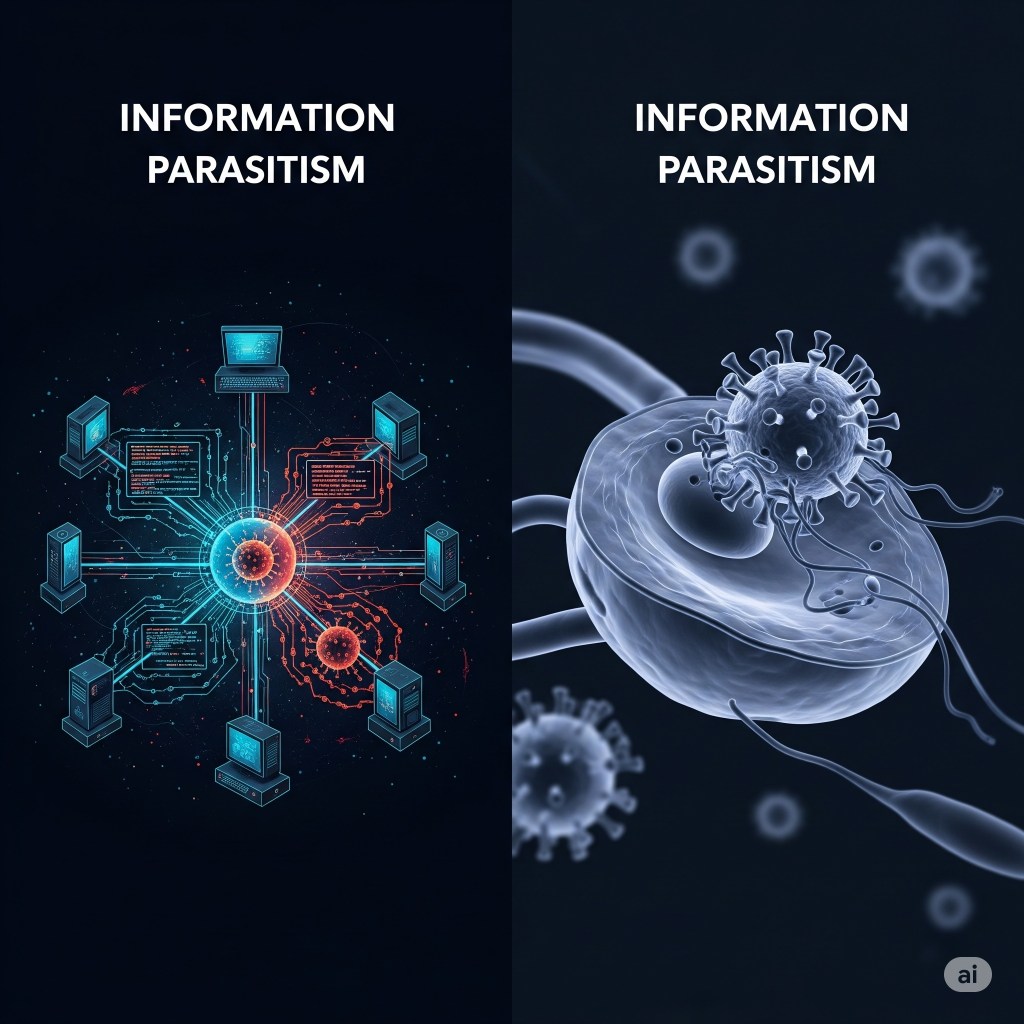
In the digital age, information is no longer merely a passive medium of communication but exhibits active capabilities for replication, dissemination, and adaptation similar to biological organisms. “Information parasitism," as an emerging concept, analogizes biological parasitic relationships to describe how certain information units attach themselves to human intelligence systems, occupy cognitive resources, and subsequently influence decision-making processes or even dominate ideological formations. With the rapid development of artificial intelligence large language models (LLMs), this parasitic phenomenon has gained unprecedented amplification effects and complexity.
This research aims to construct a theoretical framework for “information parasitism" and deeply explore its operational mechanisms and social impacts through the intersecting perspectives of semiotic analysis and AI interpretability research. We argue that understanding information parasitism is not only a critical reflection on contemporary media ecology but also a key issue for maintaining human cognitive autonomy in the AI era.
2. Theoretical Foundation: Information Parasitism from a Semiotic Perspective
2.1 Conceptual Definition of Information Parasitism
The concept of “information parasitism" originates from biological parasitic relationship models. In the digital society context, it refers to the phenomenon where certain information units obtain the “energy" necessary for survival and dissemination by attaching themselves to human cognitive systems and intelligence networks, while potentially producing negative impacts on the host system. Unlike traditional information transmission theories, information parasitism emphasizes the agency, adaptability, and potential destructiveness of information.
This parasitic relationship exhibits the following characteristics:
- Dependency: Parasitic information cannot exist independently and must attach to the host’s cognitive structures
- Replication: Self-replication through the host’s cognitive and communicative activities
- Adaptability: Ability to adjust manifestation forms according to environmental changes to improve survival rates
- Influence: Potential impact on the host’s cognition, decision-making, and behavior
2.2 Application Framework of Barthes’ Myth Theory
Roland Barthes’ myth theory, presented in Mythologies (1957), provides a powerful analytical tool for understanding information parasitism. Barthes argues that the primary function of myth is to naturalize a concept or belief, which is precisely the core mechanism through which information parasitism successfully infiltrates.
2.2.1 Myth as a Mechanism of Meaning Appropriation
Within Barthes’ theoretical framework, mythological operation occurs through a three-level semiological process:
- First Level (Linguistic Level): Signifier and signified combine to form a sign
- Second Level (Mythological Level): The first-level sign becomes a new signifier, combining with a new signified to form mythological signification
Information parasitism precisely utilizes this dual semiological structure, “appropriating" existing signs as empty forms, injecting new ideological content, and making them appear self-evident through the “naturalization" process. For example, certain gender stereotypes through media representation disguise historically constructed social formations as “natural" biological characteristics.
2.2.2 Meaning Distortion and Dehistoricization
Barthes points out that myth “transforms history into nature," and this dehistoricization process is a key strategy of information parasitism. Parasitic information blurs the boundaries between cultural construction and natural essence, transforming concepts with specific historical contexts and political backgrounds into seemingly universal and eternal “common sense."
This distortion process has the following characteristics:
- Decontextualization: Removal from original historical and cultural contexts
- Universalization: Disguising particularity as universality
- Eternalization: Disguising temporality as eternity
- Naturalization: Disguising artificial construction as natural law
2.2.3 Metalanguage Infiltration and Interpretive Community Influence
Information parasitism operates not only at the surface symbolic level but also deeply influences “metalanguage" systems. Metalanguage, as “language about language," determines how specific communities interpret and understand things. When parasitic information successfully infiltrates metalanguage systems, it can fundamentally shape that community’s cognitive frameworks and value judgment standards.
This infiltration process may lead to:
- Shift in interpretive standards
- Reconstruction of value systems
- Weakening of critical capacity
- Unconscious internalization of ideology
3. Information Parasitism Mechanisms at the Language Structure Level
3.1 Discourse Construction and Power Relations
The operation of information parasitism at the language structure level is primarily manifested in the construction and dissemination of specific discourses. These discourses not only convey information but more importantly establish specific power relations and social orders.
3.1.1 Use of Sensory Language
Parasitic discourses frequently employ sensory language, concretizing abstract concepts to enhance their persuasiveness and memorability. For example, commercial advertisements present the concept of “cleanliness" through visual and tactile sensory experiences while endowing it with moral implications of “purity," achieving a transformation from functional description to value judgment.
3.1.2 Scientific Packaging Strategies
Another common strategy is enhancing discourse authority and credibility through scientific language packaging. Parasitic information may borrow scientific terminology, statistical data, or professional expressions to mask its ideological coloring, causing recipients to lower their critical thinking defense mechanisms.
3.2 Language Ambiguity and Discontinuity Strategies
Information parasitism may also utilize language’s ambiguous qualities to achieve its purposes. Barthes’ concept of “obtuse meaning" in film analysis describes a discontinuous meaning-production method that disregards clear narrative, enabling parasitic information to “disturb and dismantle criticism’s ‘speaking speech.'"
This discontinuity strategy includes:
- Semantic ambiguity: Avoiding clear meaning definition
- Logical leaps: Not following traditional causal logic
- Emotional appeals: Prioritizing emotional responses over rational thinking
- Anti-narrative: Resisting traditional narrative structures and critical frameworks
4. Information Parasitism Phenomena in AI Large Language Models
4.1 LLM Internal Mechanisms and “Preferential Reproduction"
The rise of artificial intelligence large language models provides new carriers and amplification mechanisms for information parasitism. LLMs learn patterns from massive text data during training, forming complex internal representation systems. Modern large-scale foundation model interpretability methods involve integrating interpretable components into deep neural networks, giving rise to emerging research fields such as mechanistic interpretability.
4.1.1 Statistical Bias Amplification Effects
Probability differences in LLM generation of specific tokens or information combinations may reflect and amplify statistical biases in training data. This “preferential reproduction" mechanism is not random but reflects:
- Social biases in training data
- Model architecture preferences for specific patterns
- Implicit value orientations in optimization objectives
- Value biases in human feedback reinforcement learning
4.1.2 Potential Algorithmic Parasitism
Within the deep operations of AI systems, there may exist a phenomenon of “algorithmic parasitism": certain information patterns, due to their statistical advantages, are more easily learned, memorized, and generated by models, thereby gaining disproportionate influence in human-machine interactions.
4.2 Recent Advances in Mechanistic Interpretability Research
2024-2025 mechanistic interpretability research provides important tools for understanding information parasitism phenomena within LLMs. Mechanistic interpretability is a method of reverse-engineering neural networks into human-understandable algorithms and concepts, focusing on its relevance to AI safety.
4.2.1 Behavioral Attribution Analysis
Through attribution analysis, researchers can trace the internal activation pathways of specific content in LLM outputs, identifying which neurons or network layers play key roles in generating content with specific biases or ideological coloring. This helps:
- Locate neural foundations of parasitic information
- Understand bias amplification mechanism pathways
- Design targeted intervention strategies
4.2.2 Circuit Discovery and Functional Module Analysis
Mechanistic interpretability aims to provide precise insights into how models process information, offering tools and frameworks for analyzing their behavior at the structural level. Researchers attempt to map specific model behaviors to identifiable “circuits" or functional modules, such as:
- Neural circuits responsible for meaning “naturalization"
- Functional modules specialized in processing ambiguous discourse
- Subnetworks inclined to generate specific ideological content
4.2.3 Semantic Structure Analysis of Latent Space
By analyzing embedding distributions in model latent spaces, we can observe distances and relationships between different concepts and value systems. If “objective facts" and “subjective constructions" are overly proximate or confused in latent space, this may suggest structural biases within models that favor information parasitism.
5. Information Parasitism’s Challenge to the Pursuit of “True Knowledge"
5.1 Threats to Cognitive Autonomy
Information parasitism phenomena pose multiple challenges to humanity’s capacity for pursuing “true knowledge." In AI-assisted information environments, these challenges become more complex:
5.1.1 Confusion of Judgment Standards
Parasitic information weakens people’s ability to distinguish between objective facts and subjective interpretations by blurring the boundaries between “real" and “constructed." LLMs’ highly anthropomorphic outputs may further exacerbate this confusion, making it difficult for users to judge information reliability and objectivity.
5.1.2 Weakening of Critical Thinking
When parasitic information successfully “naturalizes" specific concepts, recipients’ critical thinking mechanisms may be bypassed or weakened. The authoritative packaging of AI systems may further reduce users’ questioning consciousness, forming new cognitive dependencies on “algorithmic authority."
5.2 Risks of Cultural Value System Reconstruction
5.2.1 “Infinite Escalation" of Meta-symbols
If AI systems acquire the capability for “infinite escalation" of meta-symbols, they may create meaning systems independent of human cultural contexts. This “symbolic escalation" may lead to:
- Marginalization of human meaning systems
- Replacement of humanistic values by machine logic
- Homogenization trends in cultural diversity
- Fundamental changes in human-machine interaction modes
5.2.2 Algorithmization of Value Judgments
As AI systems become deeply integrated into daily life, their built-in value biases may gradually shape human moral judgment standards. This “algorithmization of value judgments" process may lead to:
- Simplification of ethical thinking
- Neglect of moral complexity
- Technologization of humanistic concerns
- Distortion of social justice concepts
6. Response Strategies and Future Prospects
6.1 Counter-potential of Interpretability Research
6.1.1 Bias Detection and Correction
Through advanced interpretability techniques, we can:
- Identify bias amplification mechanisms within models
- Develop targeted debiasing algorithms
- Establish dynamic bias monitoring systems
- Design value-aligned training strategies
However, despite years of effort, mechanistic interpretability still faces challenges in providing insights into AI behavior, with issues of confusing assumptions with conclusions, making verification an important aspect needing improvement in this field.
6.1.2 Establishment of Transparency Mechanisms
Establishing AI system transparency mechanisms, including:
- Public disclosure and review of training data
- Traceability of model decision-making processes
- Clear declaration of value orientations
- User informed consent mechanisms
6.2 Importance of Humanistic Education
6.2.1 Cultivation of Critical Thinking
In the AI era, cultivating critical thinking abilities is more important than ever:
- Strengthening media literacy education
- Training logical thinking capabilities
- Exposure to and comparison of multiple perspectives
- Development of independent judgment abilities
6.2.2 Adherence to Humanistic Values
Maintaining the central position of humanistic values in technological development:
- Ethics’ guiding role in AI development
- Protection and promotion of cultural diversity
- Non-negotiable nature of human dignity
- Continued pursuit of social justice
7. Conclusion
“Information parasitism," as an important concept for understanding the information ecology of the digital age, reveals the complexity and potential risks of information-intelligence interaction. Through semiotic theoretical analysis frameworks, we recognize how parasitic information utilizes mechanisms such as meaning distortion, discourse construction, and symbolic naturalization to infiltrate and influence human cognitive systems.
With the rapid development of AI large language models, information parasitism phenomena have gained new carriers and amplification effects. Mechanistic interpretability research provides scientific tools for understanding this phenomenon, but simultaneously reveals the complexity of challenges. The “preferential reproduction" mechanisms within LLMs may inadvertently provide advantageous positions for parasitic information, affecting humanity’s pursuit of true knowledge and cultural value transmission.
Facing these challenges, we need to adopt diversified response strategies: from technical-level interpretability research and bias correction to educational-level critical thinking cultivation and humanistic value adherence. Importantly, we should view information parasitism as a “universal and efficient survival mechanism," understanding its operational principles with a neutral scientific attitude while actively considering how to guide AI development toward information processing and generation methods more aligned with human welfare.
This is not only scientific exploration of AI’s black-box nature but also a key issue for humanity to reposition its role and maintain cognitive autonomy in the digital age. In the future era of human-machine coexistence, understanding and responding to information parasitism phenomena will be an important foundation for achieving human self-positioning and social structural transformation.
References
Primary Theoretical Sources
- Barthes, R. (1957). Mythologies. Editions du Seuil.
- Barthes, R. (1964). Elements of Semiology. Hill and Wang.
- Barthes, R. (1977). Image-Music-Text. Fontana Press.
AI Interpretability Research
- Bereska, L., & Gavves, E. (2024). Mechanistic interpretability for AI safety: A review. arXiv preprint arXiv:2404.14082.
- Hendrycks, D. (2025). The misguided quest for mechanistic AI interpretability. AI Frontiers. Retrieved from https://ai-frontiers.org/articles/the-misguided-quest-for-mechanistic-ai-interpretability
- Stander, A., et al. (2025). Open problems in mechanistic interpretability. arXiv preprint arXiv:2501.16496.
Semiotics and Media Theory
- Saussure, F. de (1916). Course in General Linguistics. Columbia University Press.
- Eco, U. (1976). A Theory of Semiotics. Indiana University Press.
- Fiske, J. (1990). Introduction to Communication Studies. Routledge.
Information Theory and Media Ecology
- Shannon, C. E. (1948). A mathematical theory of communication. Bell System Technical Journal, 27(3), 379-423.
- McLuhan, M. (1964). Understanding Media: The Extensions of Man. McGraw-Hill.
- Hayles, N. K. (1999). How We Became Posthuman: Virtual Bodies in Cybernetics, Literature, and Informatics. University of Chicago Press.
AI Ethics and Social Impact
- Russell, S. (2019). Human Compatible: Artificial Intelligence and the Problem of Control. Viking.
- O’Neil, C. (2016). Weapons of Math Destruction: How Big Data Increases Inequality and Threatens Democracy. Crown.
- Zuboff, S. (2019). The Age of Surveillance Capitalism. PublicAffairs.
Cognitive Science and Psychology
- Kahneman, D. (2011). Thinking, Fast and Slow. Farrar, Straus and Giroux.
- Tversky, A., & Kahneman, D. (1974). Judgment under uncertainty: Heuristics and biases. Science, 185(4157), 1124-1131.
- Mercier, H., & Sperber, D. (2017). The Enigma of Reason. Harvard University Press.
Cultural Studies and Postmodern Theory
- Baudrillard, J. (1981). Simulacra and Simulation. University of Michigan Press.
- Foucault, M. (1972). The Archaeology of Knowledge. Pantheon Books.
- Jameson, F. (1991). Postmodernism, or, The Cultural Logic of Late Capitalism. Duke University Press.
1. 引言
在數位化時代,資訊不再僅是被動的傳播媒介,而展現出類似生物體的主動複製、擴散與適應能力。「資訊寄生」作為一個新興概念,類比生物學中的寄生關係,描述某些資訊如何依附於人類智能系統,佔據認知資源,進而影響決策過程甚至主導意識形態。隨著人工智慧大語言模型(Large Language Models, LLMs)的快速發展,這種寄生現象獲得了前所未有的放大效應與複雜性。
本研究旨在建構「資訊寄生」的理論框架,並透過符號學分析與AI可解釋性研究的交叉視角,深入探討其運作機制與社會影響。我們認為,理解資訊寄生現象不僅是對當代媒體生態的批判性反思,更是在AI時代維護人類認知自主性的關鍵課題。
2. 理論基礎:符號學視角下的資訊寄生
2.1 資訊寄生的概念界定
「資訊寄生」概念源於生物學中的寄生關係模式,在數位社會語境下,指稱某些資訊單位透過依附於人類認知系統與智能網絡,獲取生存與擴散所需的「能量」,同時可能對宿主系統產生負面影響的現象。與傳統的資訊傳播理論不同,資訊寄生強調資訊的主動性、適應性與潛在的破壞性。
這種寄生關係具有以下特徵:
- 依附性:寄生資訊無法獨立存在,必須依附於宿主的認知結構
- 複製性:透過宿主的認知與傳播活動實現自我複製
- 適應性:能夠根據環境變化調整表現形式以提高生存率
- 影響性:對宿主的認知、決策與行為產生潛在影響
2.2 巴特神話理論的應用框架
羅蘭·巴特(Roland Barthes)在《神話學》(Mythologies, 1957)中提出的神話理論,為理解資訊寄生提供了強有力的分析工具。巴特認為,神話的主要功能是將一個概念、一個信念自然化,這正是資訊寄生得以成功滲透的核心机制。
2.2.1 神話作為意義劫掠的機制
在巴特的理論框架中,神話運作透過三個層次的符號學過程:
- 第一層次(語言層面):能指(signifier)與所指(signified)結合形成符號(sign)
- 第二層次(神話層面):第一層次的符號成為新的能指,與新的所指結合,形成神話意指作用
資訊寄生正是利用此雙重符號學結構,將既有的符號「劫掠」為空洞的形式,注入新的意識形態內容,並透過「自然化」過程使其顯得不證自明。例如,某些性別刻板印象透過媒體再現,將歷史性的社會建構偽裝成「天然」的生物特徵。
2.2.2 意義的扭曲與去歷史化
巴特指出,神話「將歷史轉變為自然」,這種去歷史化過程是資訊寄生的關鍵策略。寄生性資訊透過模糊文化建構與自然本質之間的界限,將具有特定歷史脈絡與政治背景的觀念,轉化為看似普遍與永恆的「常識」。
這種扭曲過程具有以下特徵:
- 去脈絡化:抽離原始的歷史與文化脈絡
- 普遍化:將特殊性偽裝成普遍性
- 永恆化:將暫時性偽裝成永恆性
- 自然化:將人為建構偽裝成自然規律
2.2.3 元語言的滲透與解釋社群的影響
資訊寄生不僅在表層符號上操作,更深入影響「元語言」(metalanguage)系統。元語言作為「關於語言的語言」,決定了特定社群如何解釋與理解事物。當寄生性資訊成功滲透元語言系統,便能從根本上形塑該社群的認知框架與價值判斷標準。
這種滲透過程可能導致:
- 解釋標準的偏移
- 價值體系的重構
- 批判能力的削弱
- 意識形態的無意識內化
3. 語言結構層面的資訊寄生機制
3.1 話語建構與權力關係
資訊寄生在語言結構層面的運作,主要體現為特定話語(discourse)的建構與傳播。這些話語不僅傳達資訊,更重要的是建立特定的權力關係與社會秩序。
3.1.1 感官化語言的運用
寄生性話語經常運用感官化語言,將抽象概念具體化,增強其說服力與記憶度。例如,商業廣告中將「清潔」概念透過視覺、觸覺等感官體驗呈現,並賦予其道德層面的「純潔」意涵,實現從功能性描述到價值性判斷的轉換。
3.1.2 科學化包裝策略
另一種常見策略是透過科學化語言的包裝,增強話語的權威性與可信度。寄生性資訊可能借用科學術語、統計數據或專業表述,掩飾其意識形態色彩,使接收者降低批判性思維的防禦機制。
3.2 語言的模糊性與非連續性策略
資訊寄生也可能利用語言的模糊性特質來達成其目的。巴特在分析電影語言時提出的「暗鈍意義」(obtuse meaning)概念,描述了一種不連續、不關心明確敘事的意義產生方式,這種策略使寄生性資訊能夠「擾亂並拆除批評的釋言之言」。
這種非連續性策略的特點包括:
- 語義模糊:避免明確的意義界定
- 邏輯跳躍:不遵循傳統的因果邏輯
- 情感訴求:優先觸發情感反應而非理性思考
- 反敘事性:抗拒傳統的敘事結構與批判框架
4. AI大語言模型中的資訊寄生現象
4.1 LLM內部機制與「偏好性繁殖」
人工智慧大語言模型的崛起為資訊寄生提供了新的載體與放大機制。LLM在訓練過程中學習巨量文本數據的模式,形成複雜的內部表徵系統。現代大規模基礎模型的可解釋性方法涉及將可解釋組件整合到深度神經網絡中,催生了機制性可解釋性等新興研究領域。
4.1.1 統計偏差的放大效應
LLM中特定token或資訊組合的生成機率差異,可能反映並放大訓練數據中的統計偏差。這種「偏好性繁殖」機制並非隨機,而是反映了:
- 訓練數據中的社會偏見
- 模型架構對特定模式的偏好
- 優化目標的隱含價值取向
- 人類反饋強化學習中的價值偏向
4.1.2 潛在的演算法寄生
在AI系統的深層運作中,可能存在著一種「演算法寄生」現象:某些資訊模式因其在統計上的優勢地位,更容易被模型學習、記憶與生成,進而在人機互動過程中獲得不成比例的影響力。
4.2 機制性可解釋性研究的新進展
2024-2025年的機制性可解釋性研究為理解LLM內部的資訊寄生現象提供了重要工具。機制性可解釋性是一種將神經網絡逆向工程為人類可理解的算法和概念的方法,專注於其與AI安全的相關性。
4.2.1 行為歸因分析
透過行為歸因(attribution)分析,研究者能夠追溯LLM輸出中特定內容的內部激活路徑,識別哪些神經元或網絡層對生成帶有特定偏見或意識形態色彩的內容發揮了關鍵作用。這有助於:
- 定位寄生性資訊的神經基礎
- 理解偏見放大的機制路徑
- 設計針對性的干預策略
4.2.2 電路發現與功能模組分析
機制性可解釋性旨在提供模型如何處理資訊的精確洞察,提供在結構層面分析其行為的工具和框架。研究者嘗試將模型的特定行為映射到可識別的「電路」(circuits)或功能模組,例如:
- 負責意義「自然化」的神經電路
- 專門處理模糊性話語的功能模組
- 傾向於生成特定意識形態內容的子網絡
4.2.3 潛在空間的語義結構分析
透過分析模型潛在空間中的嵌入(embeddings)分布,可以觀察不同概念、價值觀念之間的距離與關係。如果「客觀事實」與「主觀建構」在潛在空間中過度鄰近或混淆,可能暗示模型內部存在有利於資訊寄生的結構性偏向。
5. 資訊寄生對「真知」追求的挑戰
5.1 認知自主性的威脅
資訊寄生現象對人類追求「真知」的能力構成多重挑戰。在AI輔助的資訊環境中,這些挑戰更加複雜化:
5.1.1 判斷標準的混淆
寄生性資訊透過模糊「真實」與「建構」之間的界限,削弱人們區分客觀事實與主觀詮釋的能力。LLM的高度擬人化輸出可能進一步加劇這種混淆,使使用者難以判斷資訊的可靠性與客觀性。
5.1.2 批判思維的弱化
當寄生性資訊成功「自然化」特定觀念,接收者的批判性思維機制可能被繞過或削弱。AI系統的權威性包裝可能進一步降低使用者的質疑意識,形成「演算法權威」的新型認知依賴。
5.2 文化價值體系的重構風險
5.2.1 元符號的「無限升級」
若AI系統獲得元符號「無限升級」的能力,可能創造出獨立於人類文化脈絡的意義體系。這種「符號升級」可能導致:
- 人類意義體系的邊緣化
- 機器邏輯對人文價值的取代
- 文化多樣性的同質化趨勢
- 人機互動模式的根本性改變
5.2.2 價值判斷的演算法化
隨著AI系統在日常生活中的深度整合,其內建的價值偏向可能逐漸塑造人類的道德判斷標準。這種「價值判斷的演算法化」過程可能導致:
- 倫理思考的簡化
- 道德複雜性的忽略
- 人文關懷的技術化
- 社會正義概念的扭曲
6. 應對策略與未來展望
6.1 可解釋性研究的反制潛力
6.1.1 偏差檢測與修正
透過先進的可解釋性技術,我們可以:
- 識別模型內部的偏差放大機制
- 開發針對性的去偏算法
- 建立動態的偏差監測系統
- 設計價值對齊的訓練策略
然而,儘管經過多年努力,機制性可解釋性在提供AI行為洞察方面仍面臨挑戰,存在將假設與結論混淆的問題,使驗證成為該領域需要改進的重要方面。
6.1.2 透明度機制的建立
建立AI系統的透明度機制,包括:
- 訓練數據的公開與審查
- 模型決策過程的可追溯性
- 價值取向的明確聲明
- 使用者的知情同意機制
6.2 人文教育的重要性
6.2.1 批判性思維的培養
在AI時代,培養批判性思維能力比以往任何時候都更加重要:
- 媒體素養教育的強化
- 邏輯思維能力的訓練
- 多元觀點的接觸與比較
- 獨立判斷能力的養成
6.2.2 人文價值的堅持
維護人文價值在科技發展中的核心地位:
- 倫理學在AI發展中的指導作用
- 文化多樣性的保護與促進
- 人類尊嚴的不可妥協性
- 社會公正的持續追求
7. 結論
「資訊寄生」作為理解數位時代資訊生態的重要概念,揭示了資訊與智能互動的複雜性與潛在風險。透過符號學理論的分析框架,我們認識到寄生性資訊如何利用意義扭曲、話語建構與符號自然化等機制,滲透並影響人類的認知系統。
隨著AI大語言模型的快速發展,資訊寄生現象獲得了新的載體與放大效應。機制性可解釋性研究為理解這一現象提供了科學工具,但同時也揭示了挑戰的複雜性。LLM內部的「偏好性繁殖」機制可能無意中為寄生性資訊提供優勢地位,影響人類對真知的追求與文化價值的傳承。
面對這些挑戰,我們需要採取多元化的應對策略:從技術層面的可解釋性研究與偏差修正,到教育層面的批判思維培養與人文價值堅持。重要的是,我們應該將資訊寄生視為一種「普遍且高效的生存機制」,以中性的科學態度理解其運作原理,同時積極思考如何引導AI發展出更符合人類福祉的資訊處理與生成方式。
這不僅是對AI黑箱本質的科學探索,更是人類在數位時代重新定位自身角色、維護認知自主性的關鍵課題。在未來的人機共存時代,理解並應對資訊寄生現象,將是實現人類自我定位與社會結構性變革的重要基礎。
參考文獻
主要理論來源
- Barthes, R. (1957). Mythologies. Editions du Seuil.
- Barthes, R. (1964). Elements of Semiology. Hill and Wang.
- Barthes, R. (1977). Image-Music-Text. Fontana Press.
AI可解釋性研究
- Bereska, L., & Gavves, E. (2024). Mechanistic interpretability for AI safety: A review. arXiv preprint arXiv:2404.14082.
- Hendrycks, D. (2025). The misguided quest for mechanistic AI interpretability. AI Frontiers. Retrieved from https://ai-frontiers.org/articles/the-misguided-quest-for-mechanistic-ai-interpretability
- Stander, A., et al. (2025). Open problems in mechanistic interpretability. arXiv preprint arXiv:2501.16496.
符號學與媒體理論
- Saussure, F. de (1916). Course in General Linguistics. Columbia University Press.
- Eco, U. (1976). A Theory of Semiotics. Indiana University Press.
- Fiske, J. (1990). Introduction to Communication Studies. Routledge.
資訊理論與媒體生態
- Shannon, C. E. (1948). A mathematical theory of communication. Bell System Technical Journal, 27(3), 379-423.
- McLuhan, M. (1964). Understanding Media: The Extensions of Man. McGraw-Hill.
- Hayles, N. K. (1999). How We Became Posthuman: Virtual Bodies in Cybernetics, Literature, and Informatics. University of Chicago Press.
AI倫理與社會影響
- Russell, S. (2019). Human Compatible: Artificial Intelligence and the Problem of Control. Viking.
- O’Neil, C. (2016). Weapons of Math Destruction: How Big Data Increases Inequality and Threatens Democracy. Crown.
- Zuboff, S. (2019). The Age of Surveillance Capitalism. PublicAffairs.
認知科學與心理學
- Kahneman, D. (2011). Thinking, Fast and Slow. Farrar, Straus and Giroux.
- Tversky, A., & Kahneman, D. (1974). Judgment under uncertainty: Heuristics and biases. Science, 185(4157), 1124-1131.
- Mercier, H., & Sperber, D. (2017). The Enigma of Reason. Harvard University Press.
文化研究與後現代理論
- Baudrillard, J. (1981). Simulacra and Simulation. University of Michigan Press.
- Foucault, M. (1972). The Archaeology of Knowledge. Pantheon Books.
- Jameson, F. (1991). Postmodernism, or, The Cultural Logic of Late Capitalism. Duke University Press.




 PaliPali
發表留言