
Back in university, I was always drawn to courses on design thinking. Recently, I came across a discussion on social media about industrial designers who have spent 20 to 30 years in the field, now approaching their 50s, and contemplating their next steps. Retirement planning and starting a new business are common considerations, but I couldn’t help reflecting on something AMD Chair and CEO Lisa Su once said: “All education is learning to think; it’s about learning to problem-solve.”
Force on “problem-solve" learning first
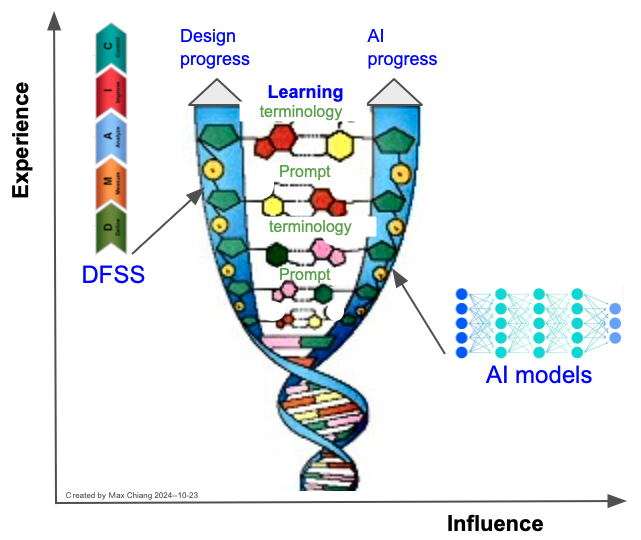
This brings me back to the concept of “learning” as another answer—especially with AI as an ally in this process. I’ve been developing a design thinking model, which I’d like to share with you all (see attached image). Its core inspiration comes from the double helix structure of DNA. One strand represents the iterative design cycle of DFSS (Design for Six Sigma), while the other embodies the evolution of AI models. It may seem unconventional, but I believe it has potential for further exploration. Combining years of hands-on experience with this framework for design thinking could open up exciting opportunities, perhaps a Master in a specialized field.
設計思維:人工智慧時代中解決問題的新視角
在大學時期,我總是對設計思維的課程特別感興趣。最近在社群媒體上看到一則討論,內容是關於那些在工業設計領域已耕耘二、三十年的資深設計師們,他們現在接近五十歲,開始思考人生下一步的方向。規劃退休或創業是常見的選項,但我不禁想到 AMD 董事長暨執行長蘇姿丰曾說過的一句話:「所有的教育,都是在學習如何思考;它的本質是學習如何解決問題。」
這句話讓我再次聚焦在「解決問題的學習」這件事上——特別是在 AI 成為我們盟友的今天。「學習」本身,也許正是另一個答案。
我近期一直在發展一套設計思維模型,很想與大家分享(請見附圖)。它的核心靈感來自 DNA 的雙螺旋結構,其中一條螺旋象徵 DFSS(為六標準差而設計)的設計迴圈,而另一條則代表 AI 模型的進化。雖然這樣的想法看似非傳統,但我相信它具有深入發展的潛力。將多年實務經驗與這套設計思維框架結合,或許能開啟一些令人振奮的可能性——例如,攻讀一門專業領域的碩士學位。



 PaliPali
發表留言