
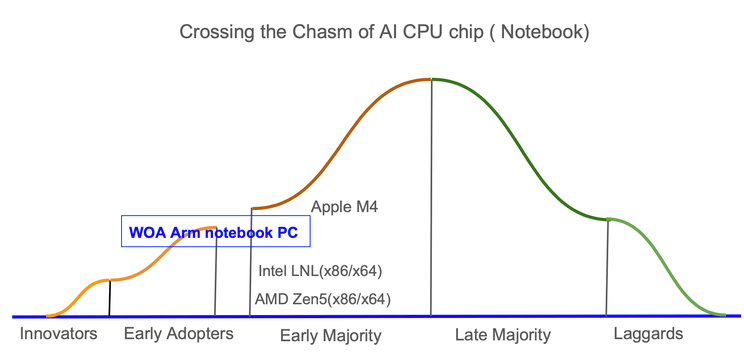
In the ICT industry, Notebooks and smartphones represent two of the highest-value device categories. As AI technology advances, these devices venders face unprecedented challenges and opportunities that will shape their development trajectory.
The Core of ICT – Data Consumption and Creation:
Smartphones are primarily focused on data “consumption,” aiming to deliver information effectively to users, while Notebooks emphasize data “creation,” providing tools for users to efficiently complete tasks. For years, the Wintel architecture (Windows and Intel) has dominated the Notebook market. However, Intel now faces significant challenges—not only in lagging behind TSMC in semiconductor technology but also in contending with Microsoft and Qualcomm’s new Windows on Arm (WOA) architecture.
Traditionally, Arm CPUs have powered Android smartphones, with limited use in Chromebooks. Today, Arm is expanding into Microsoft’s notebook ecosystem, directly challenging x86 platform position. Microsoft’s decision to support both x86 and Arm reflects a dual-platform strategy that, while initially disadvantaging x86 platform, has spurred Intel to innovate. By collaborating with TSMC on 3nm technology and releasing its latest AI-focused CPU, LNL, Intel has reduced the energy-efficiency gap with Qualcomm, potentially reducing Arm’s competitive edge.
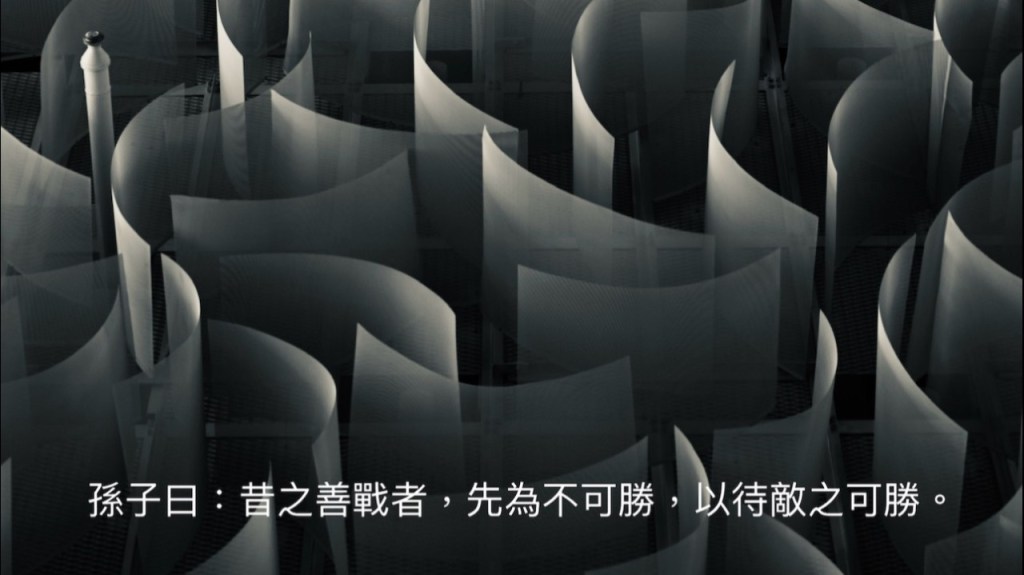
The good fighters of old first put themselves beyond the possibility of defeat, and then waited for an opportunity of defeating the enemy.
(Sun Tzu’s Art of War IV. Tactical Dispositions)
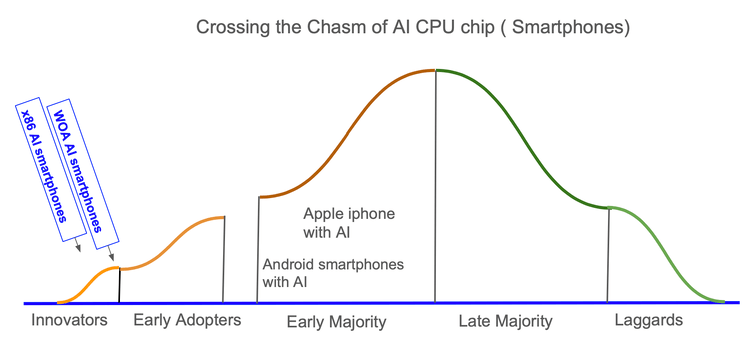
If WOA platform will enter smartphone market in the future, the rise of AI presents x86 platform with an opportunity to enter the smartphone market, too. By narrowing its power-efficiency gap with Arm, x86 platform could, through its partnership with Microsoft and solid ecosystem, to use same TSMC 3nm and CoWoS IC process, secure a position in the smartphone space and challenge Android ecosystem, turning what was once a threat into a significant growth opportunity.
Moving forward, x86 and Arm platforms are likely to compete across both notebooks and smartphones in the AI edge device space, with Microsoft potentially emerging as the biggest beneficiary. Meanwhile, Android smartphones will face new challenges. In this competitive landscape, the concept of a two-sided market will be crucial, as the interdependence between Notebooks and smartphones drives new collaborations and intensified competition across architectures, opening fresh growth avenues in the ICT industry.
As AI technology progresses, the architecture options available to the ICT industry will become more flexible and diverse. The Coopetition (競合, cooperation +competition) among x86, Arm, windows, and Android will not only drive technical innovation but also reshape the industry’s future landscape. The coming years promise to mark a peak in AI device development.
人工智慧裝置中 CPU 與作業系統的挑戰與機會
在資訊與通訊科技(ICT)產業中,筆記型電腦與智慧型手機是兩大高價值的裝置類別。隨著人工智慧技術的快速發展,這些裝置的製造商正面臨前所未有的挑戰與機會,這將深刻影響未來的發展路徑。
ICT 核心:資料的消費與創造
智慧型手機主要聚焦於資料「消費」,致力於有效地向使用者傳遞資訊;而筆記型電腦則強調資料「創造」,提供使用者完成任務所需的工具。長久以來,Wintel 架構(Windows 與 Intel)一直主導筆記型電腦市場。然而,Intel 現今正面臨嚴峻挑戰——不僅在半導體製程上落後台積電,也需因應微軟與高通攜手推出的新一代 Windows on Arm(WOA)架構。
傳統上,Arm 架構的 CPU 多用於 Android 智慧型手機,在 Chromebook 上的應用也相對有限。但如今,Arm 正逐步進入微軟筆記型電腦的生態系統,對 x86 平台形成直接挑戰。微軟選擇同時支援 x86 與 Arm,反映出其雙平台策略。這項策略雖在初期對 x86 平台造成壓力,卻也促使 Intel 加快創新腳步。透過與台積電合作開發 3 奈米製程技術,以及推出以 AI 為核心的新一代處理器 LNL,Intel 已縮小與高通之間在能效上的差距,可能進一步削弱 Arm 的競爭優勢。
古之善戰者,先為不可勝,以待敵之可勝。
(孫子兵法.軍形篇 第四)
若未來 WOA(Windows on Arm)平台進軍智慧型手機市場,那麼 AI 的崛起也為 x86 平台打開了一扇進入手機市場的機會之門。透過縮小與 Arm 在功耗效率上的差距,x86 平台結合與微軟的合作關係與完整的軟硬體生態系統,亦可利用台積電 3 奈米與 CoWoS 等先進封裝製程,在智慧型手機市場中取得一席之地,挑戰現有的 Android 生態體系,化威脅為成長機會。
展望未來,x86 與 Arm 兩大平台勢必將在筆記型電腦與智慧型手機兩個 AI 邊緣裝置領域全面交鋒,而微軟有可能成為這場競爭中的最大受益者。與此同時,Android 智慧型手機市場將面臨新的挑戰。在這樣的競爭格局中,「雙邊市場」的概念將變得格外關鍵——筆電與手機間日益加深的相互依存,將催生新的合作模式,也將在不同架構間加劇競爭,為 ICT 產業開啟嶄新的成長契機。
隨著 AI 技術不斷進步,ICT 產業在架構選擇上將變得更加彈性且多元。x86、Arm、Windows 與 Android 之間的「競合」(Coopetition,意指合作與競爭並存)不僅將持續推動技術創新,也將重塑整個產業的未來格局。未來幾年,勢必將成為 AI 裝置發展的高峰期。




 PaliPali
發表留言