

Navigating Cross-Disciplinary Challenges in Computer Product Development
In computer product development, one of the most challenging aspects is determining which department should take ownership of an issue. As a design director, making the right decision on which team should conduct the initial experimental analysis is crucial. A misattribution can lead to a significant loss of valuable time, delaying problem resolution. The complexity is heightened when the issue arises at the intersection of hardware and software, where it becomes difficult to pinpoint the root cause.
While it might seem intuitive to distinguish whether an issue stems from hardware or software, real-world cases often prove otherwise. If the distinction were straightforward, there would be little dispute among departments, and project managers could easily oversee the resolution process. However, when conflicts and uncertainties arise, it often signals a deeply embedded and complex issue—potentially even a fundamental flaw in the chip design itself.
A mixed hardware-software problem typically suggests an architectural ambiguity, where hardware and software are not optimally aligned. Every electronic component has manufacturing tolerances that can lead to unexpected behaviors such as leakage currents or unintended triggers. Additionally, some issues may not originate from hardware tolerances but rather from EC WDT (Embedded Controller Watchdog Timer) problems. Since EC firmware is tightly integrated with hardware, controlling power transitions and sensor feedback, it frequently interacts with BIOS, ACPI, and I/O configurations. When an issue cannot be definitively classified as hardware or software-related, it becomes necessary to reassess the design architecture itself, which may contain overlooked bugs or weaknesses inherent to a new generation of chips.
Before becoming a design director, one must first excel in a specialized domain. Through extensive cross-departmental interactions and an insatiable curiosity, a specialist gradually gains a broader understanding of interdependent disciplines, earning the capability to lead across functions. Cross-disciplinary challenges serve as invaluable learning experiences for directors, providing them with opportunities to refine their problem-solving acumen.
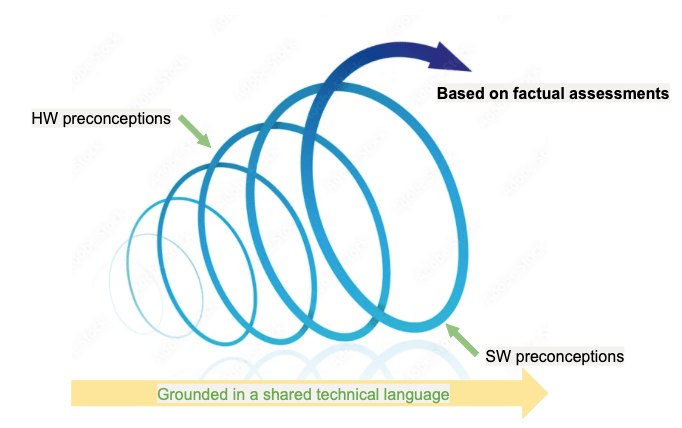
Resolving ambiguous software-hardware issues demands intensive and continuous dialectical communication. This process mirrors a fast-paced table tennis match, where ideas must be exchanged dynamically, or it can be likened to Hegel’s dialectical spiral, where iterative discussions drive toward a conclusive root cause and solution. Often, these conversations align with Jean-François Lyotard’s concept of preconceptions in postmodern philosophy. In Lyotard’s grand narratives, universality is a modern concern, while differences define postmodern discourse. Identifying and discussing these differences at the outset is critical. Unlike subjective value judgments, these preconceptions should be based on factual assessments, forming the foundation for structured viewpoints. From a hermeneutic perspective, viewpoints are constructed upon preconceptions, making it impossible to pursue truth and solutions without fully articulating them. This process, grounded in a shared technical language, is essential for problem-solving in any engineering case.
Although navigating these challenges can be exhausting, the rewards are substantial. As the saying goes, no pain, no gain.
硬體還是軟體問題:後現代哲學在工程問題解決中的應用
在電腦產品開發中的跨領域挑戰
在電腦產品開發中,最具挑戰性的一個方面是確定應由哪個部門負責處理問題。作為設計總監,做出正確的決定,選擇哪個團隊來進行初步的實驗分析至關重要。錯誤的歸屬可能會導致寶貴時間的損失,從而延誤問題的解決。當問題出現在硬體與軟體的交集處時,這種複雜性會進一步加劇,因為這樣的問題根源往往難以確定。
雖然直觀上看來,可以區分問題是否來自硬體或軟體,但現實案例往往證明並非如此。如果區分簡單,部門之間就不會有太多爭議,項目經理也可以輕鬆監督問題的解決。然而,當衝突和不確定性出現時,這通常預示著一個深層次且複雜的問題——可能甚至是晶片設計本身的基本缺陷。
混合型硬體與軟體問題通常表明架構模糊,硬體與軟體未能達到最佳對齊。每個電子元件都有製造公差,這些公差可能會導致意外的行為,例如漏電流或非預期的觸發。此外,某些問題可能並非來自硬體公差,而是來自嵌入式控制器看門狗計時器(EC WDT)問題。由於EC固件與硬體緊密集成,控制電源過渡和感測器反饋,經常與BIOS、ACPI和I/O配置交互作用。當問題無法明確分類為硬體或軟體相關時,就有必要重新評估設計架構本身,這可能包含一些未被察覺的錯誤或來自新一代晶片的內在缺陷。
在成為設計總監之前,首先必須在某一專業領域內表現出色。通過廣泛的跨部門互動和不斷的好奇心,一個專業人士逐漸對相互依賴的學科有了更廣泛的理解,並獲得了跨職能領導的能力。跨領域挑戰對總監來說是一個寶貴的學習經驗,為他們提供了磨練問題解決能力的機會。
解決模糊的軟體-硬體問題需要密集且持續的辯證性交流。這個過程可以比作一場快速的乒乓球比賽,其中思想必須動態交換,或者可以類比為黑格爾的辯證螺旋,通過反覆的討論推向最終的根本原因和解決方案。這些討論往往與讓-弗朗索瓦·利奧塔(Jean-François Lyotard)在後現代哲學中的前設概念相契合。在利奧塔的大敘事中,普遍性是現代的關注,而差異則定義了後現代的話語。在一開始識別並討論這些差異是至關重要的。與主觀價值判斷不同,這些前設應該建立在事實評估的基礎上,形成結構化的觀點基礎。從詮釋學的角度來看,觀點是建立在前設之上的,沒有充分表達這些前設,便無法追求真理和解決方案。這一過程,基於共享的技術語言,對於解決任何工程案例中的問題都是至關重要的。
儘管解決這些挑戰可能是令人疲憊的,但回報是可觀的。正如諺語所說,不勞無獲。



 PaliPali
發表留言