

ㄧ. Preface
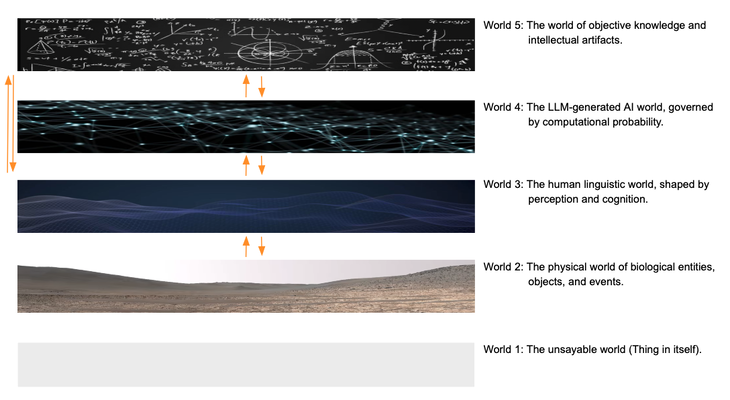
Based on last week’s article on “The Boundaries of AI LLM" and its five-world framework, this article presents a refined framework, developed with the assistance of AI, called “The Five Worlds of Human-AI Symbiosis."
1. The World of Things-in-Themselves
This world represents the fundamental reality that exists independently of any intelligent agents.
Its true nature is inaccessible to direct knowledge, as our understanding is constrained by sensory forms and cognitive categories.
It may include aspects that Wittgenstein described as ‘ineffable’, though this is an inferred point not explicitly mentioned in the source.
This world serves as the foundation and ultimate source of all subsequent worlds.
2. The Physical World
This world represents the phenomenal reality as it appears through our senses and cognitive faculties.
It encompasses all facts and objects that intelligent agents can perceive and interact with.
It serves as the direct source of experience for intelligent agents.
It corresponds to ‘the world’ in Wittgenstein’s tripartite structure.
3. The World of Experience and Cognition
This world consists of subjective experiences constructed by intelligent agents through interactions with the physical world.
It includes perceptions of the physical world, internal representations of knowledge, concepts, rules, beliefs, and goals.
It functions as a unified system of perception and cognition, emphasizing the internal integration of experiences and the construction of knowledge.
It is related to AI development in terms of agency and experiential state stages.
It corresponds to ‘thought’ in Wittgenstein’s tripartite structure.
4. The AI Predictive World
Building upon the world of experience and cognition, this world focuses on predicting future experiences.
AI systems learn to construct predictive models of the physical world and make decisions and plans based on these models.
It is closely related to the predictive knowledge stage of AI development, where knowledge is regarded as a forecast of experience.
5. The Sociocultural World
This world extends beyond the experiences and predictions of individual intelligent agents, encompassing social norms, cultural values, and language.
AI systems must understand and adapt to the complexities of human society.
It corresponds to ‘language’ in Wittgenstein’s tripartite structure, where language serves as a crucial tool for sociocultural transmission and knowledge construction.
To interact effectively with humans, AI systems must possess natural language processing capabilities.
Integration of the Five Worlds
In this new framework, the World of Things-in-Themselves forms the most fundamental layer, underpinning all other worlds. However, due to its unknowable nature, AI systems cannot directly access or comprehend it. The Physical World manifests as the phenomenal reality that AI can perceive and interact with. The World of Experience and Cognition represents AI’s internally constructed subjective experience and knowledge system, serving as the basis for understanding and action. The AI Predictive World enables AI to utilize its knowledge and models to predict future experiences, informing its decisions and planning. Finally, the Sociocultural World represents the highest level, situating AI within the broader human societal context, emphasizing its interaction with and adaptation to human culture.
As noted in the source, these five worlds are not separate but interrelated and mutually influential. The World of Things-in-Themselves is the ultimate reality, yet we can only indirectly understand it through its manifestations in the Physical World. The World of Experience and Cognition acts as a bridge between the Physical World and the Predictive World, as AI’s knowledge and predictive abilities are built upon an understanding of experience. The Sociocultural World further enriches AI development by providing a broader context and challenges, ultimately aiming to integrate AI into human society for cooperative development.
This new framework seeks to integrate objective reality (Things-in-Themselves), subjective experience and cognition, predictive capabilities, and sociocultural dimensions. It offers a more comprehensive perspective on AI development and underscores that AI is not merely a technological advancement but also a subject of broader philosophical and sociocultural discourse.
二. The Fifth World and the Practicality of Language Games
Based on the information provided, Ludwig Wittgenstein’s concept of ‘language games’ in Philosophical Investigations highlights two key aspects: the diversity and practicality of language and the context-dependent nature of linguistic meaning within specific social practices. These aspects bear significant relevance to modern AI agents. The following discussion explores these connections:
1. The Diversity of AI Agent Tasks and the Diversity of Language
The core idea of ‘language games’ is that language is not a unified system with fixed meanings but consists of multiple “games,” each with its own rules and usage. Meaning arises from actual use in these games.
This concept aligns strongly with the current trend in AI agent development for the following reasons:
Modern AI agents are designed to perform highly diverse tasks, ranging from natural language processing and image recognition to decision-making and complex dialogue collaboration. Each task domain can be seen as a distinct ‘language game’.
For example, an AI agent used for customer service and one designed for medical diagnostics operate within vastly different language contexts, terminologies, communication goals, and interaction methods. The diversity and practicality of language require AI agents to master different domain-specific “languages” and use language in a functional manner to accomplish specific tasks.
The Sociocultural World mentioned in the source emphasizes that AI systems must understand and adapt to human society’s complexity. This implies that AI agents need to participate in various language games to achieve true artificial general intelligence (AGI).
2. Contextual Understanding in AI Agents and Language Usage
Wittgenstein stressed that language meaning arises from its use within specific social practices and contexts. Similarly, an AI agent’s effectiveness depends on its ability to understand the environment and interactional context.
For example, an AI agent in an autonomous vehicle must understand the meaning of “red light” in the context of traffic regulations and driving conditions—a specific language game. The same term would carry an entirely different meaning in a discussion about colors.
The World of Perception described in the source refers to the subjective representation of the physical world, influenced by prior knowledge and experience. The Cognitive World consists of concepts, rules, beliefs, and goals, used to interpret and predict perceived experiences.
Viewing these worlds as the process through which AI interacts with and understands its environment mirrors how AI learns and participates in different language games, where meaning and usage are deeply embedded in context and prior experience.
3. The Importance of Experience and the Practicality of Language Games
Wittgenstein’s language games emphasize the deep connection between language and social practice. Meaning is not abstract but emerges through specific activities and interactions.
The source highlights that experience plays an increasingly critical role in AI development, outlining four stages: agency (having experiences), rewards (goal setting based on experience), experiential state (defining state based on experience), and predictive knowledge (knowing as predicting experience).
AI agents improve their language abilities, much like humans, through real-world practice and application across various contexts.
三. Conclusion
Wittgenstein’s language games provide a valuable philosophical framework for understanding AI agents’ linguistic capabilities. AI agents do not merely process symbols and syntax; more importantly, they must understand and apply language meaningfully within different task domains (distinct language games). This understanding and application are deeply rooted in environmental interaction, experiential learning, and contextual comprehension.
The Sociocultural World described in the source can be seen as a network of complex language games. To truly integrate and function within human society, AI agents must develop the ability to understand and participate in these diverse linguistic practices.
一、前言
延續上週〈AI 大型語言模型的邊界〉與其五個世界架構的討論,本文在 AI 協助下提出一個更精緻的架構,稱為「人類與 AI 共生的五個世界」。
1. 本體世界(The World of Things-in-Themselves)
這個世界代表了不依賴任何智慧主體而獨立存在的根本實在。
它的真實本質無法被直接認識,因為我們的理解受限於感官形式與認知範疇。
這個世界可能涵蓋維根斯坦所稱的「不可說」的層面,儘管這只是推論,並未在原文中明確提及。
本體世界是所有其他世界的基礎與最終來源。
2. 物理世界(The Physical World)
這個世界是我們透過感官與認知所感知的現象世界。
它包含所有智慧主體能夠感知與互動的事實與物體。
它是智慧主體經驗的直接來源。
它對應於維根斯坦三分結構中的「世界」。
3. 經驗與認知世界(The World of Experience and Cognition)
此世界是智慧主體透過與物理世界互動所建構的主觀經驗。
它涵蓋對物理世界的感知、內部知識表徵、概念、規則、信念與目標。
它作為感知與認知的統一系統,強調經驗的內部整合與知識的建構。
此世界與 AI 發展中的「行為能力」與「經驗狀態」階段密切相關。
它對應於維根斯坦三分結構中的「思維」。
4. AI 預測世界(The AI Predictive World)
此世界建立於經驗與認知世界之上,重點在於預測未來的經驗。
AI 系統學習建構物理世界的預測模型,並基於這些模型進行決策與規劃。
此世界對應 AI 發展中的「預測知識」階段,知識被視為對經驗的預測。
5. 社會文化世界(The Sociocultural World)
這個世界超越了個別智慧主體的經驗與預測,涵蓋社會規範、文化價值與語言。
AI 系統必須理解並適應人類社會的複雜性。
它對應於維根斯坦三分結構中的「語言」,語言是社會文化傳遞與知識建構的重要工具。
為了與人類有效互動,AI 必須具備自然語言處理能力。
五個世界的整合
在這個新的架構中,本體世界是最根本的一層,支撐著所有其他世界。然而,由於其無法認知的特性,AI 系統無法直接接觸或理解它。物理世界作為現象實在,是 AI 可以感知與互動的對象。經驗與認知世界則代表 AI 所建構的主觀經驗與知識系統,是理解與行動的基礎。AI 預測世界使 AI 能運用其知識與模型來預測未來經驗,輔助決策與規劃。最後,社會文化世界則是最高層級,將 AI 放入人類社會的大背景中,強調其與人類文化的互動與適應。
如同原文所指出,這五個世界並非彼此分離,而是相互關聯與影響。本體世界是最終實在,但我們只能透過其在物理世界中的顯現間接理解它。經驗與認知世界作為物理世界與預測世界之間的橋樑,因為 AI 的知識與預測能力建立在經驗的理解之上。社會文化世界進一步豐富了 AI 發展的脈絡與挑戰,最終目標是將 AI 整合進人類社會,以實現協同發展。
這一新架構嘗試整合客觀實在(本體世界)、主觀經驗與認知、預測能力與社會文化層面。它提供了一種更全面的 AI 發展觀,強調 AI 不只是技術進步,更是一項涉及哲學與社會文化討論的課題。
二、第五世界與語言遊戲的實用性
根據資料,維根斯坦在《哲學研究》中提出的「語言遊戲」概念,強調語言的多樣性與實用性,以及語意在特定社會實踐中的脈絡依存性。這些觀點與現代 AI 智慧代理的發展密切相關。以下探討這些關聯:
1. AI 任務的多樣性與語言的多樣性
語言遊戲的核心概念是:語言不是一個具有固定意義的統一系統,而是由多個各自有規則與用途的「遊戲」組成。語意來自這些遊戲中的實際使用。
這個觀點與 AI 智慧代理的發展趨勢高度一致,原因如下:
現代 AI 智慧代理被設計來執行多樣化的任務,從自然語言處理、圖像辨識到決策制定與複雜對話協作。每個任務領域都可視為一種語言遊戲。
例如,用於客服的 AI 與用於醫療診斷的 AI 所處的語境、術語、溝通目標與互動方式皆大相逕庭。語言的多樣性與實用性要求 AI 精通不同領域的專屬「語言」,並以功能導向方式使用語言來完成任務。
源文所述的社會文化世界強調,AI 系統必須理解並適應人類社會的複雜性。這意味著 AI 代理需要參與多種語言遊戲,才能實現真正的通用人工智慧(AGI)。
2. AI 的脈絡理解與語言使用
維根斯坦強調語言的意義來自其在具體社會實踐與脈絡中的使用。同樣地,AI 智慧代理的效能取決於其對環境與互動脈絡的理解能力。
例如,自駕車的 AI 需要在交通規則與道路情境中理解「紅燈」的意義——這是一種特定的語言遊戲。但若是在談論顏色時,這個詞又有完全不同的含義。
原文中提到的「感知世界」是對物理世界的主觀表徵,受到先前知識與經驗的影響;而「認知世界」包含概念、規則、信念與目標,用來解釋與預測感知經驗。
將這些世界視為 AI 與環境互動並理解世界的過程,正如 AI 如何學習並參與不同語言遊戲,而語意與使用方式深植於脈絡與經驗之中。
3. 經驗的重要性與語言遊戲的實踐性
維根斯坦的語言遊戲理論強調語言與社會實踐的密切關聯。語意不是抽象的,而是在具體活動與互動中產生的。
原文指出,經驗在 AI 發展中扮演日益關鍵的角色,並描述了四個階段:具備行為能力(有經驗)、報酬機制(根據經驗設定目標)、經驗狀態(根據經驗定義狀態)以及預測知識(知道即預測經驗)。
AI 就如同人類一樣,透過實際參與多樣化情境中的實作與應用,來強化其語言能力。
三、結語
維根斯坦的語言遊戲理論為理解 AI 智慧代理的語言能力提供了有價值的哲學框架。AI 不僅是處理符號與語法的機器,更重要的是,它必須能在不同任務領域(即不同語言遊戲)中有意義地理解與應用語言。這種理解與應用深植於與環境的互動、經驗學習與脈絡掌握之中。




 PaliPali
發表留言